|



|
Understanding of the branch of earth science geology, needs to be owned by various groups of society. This is because all aspects of human life depend on geological phenomena, from energy, natural resources, to disasters.
One group that can be taught about earth science is high school students. High school students are considered to still need to learn more fundamental things about earth science including geological phenomena, one of which is about how various types of rocks can be formed.
Understanding the earth has actually been taught in schools, and is included in the geography subject. In this subject, it has been taught how the earth interacts with social life on it. However, more interesting activities need to be held, so that the knowledge given can be better absorbed and imprinted in the minds of students.
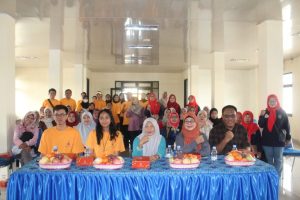
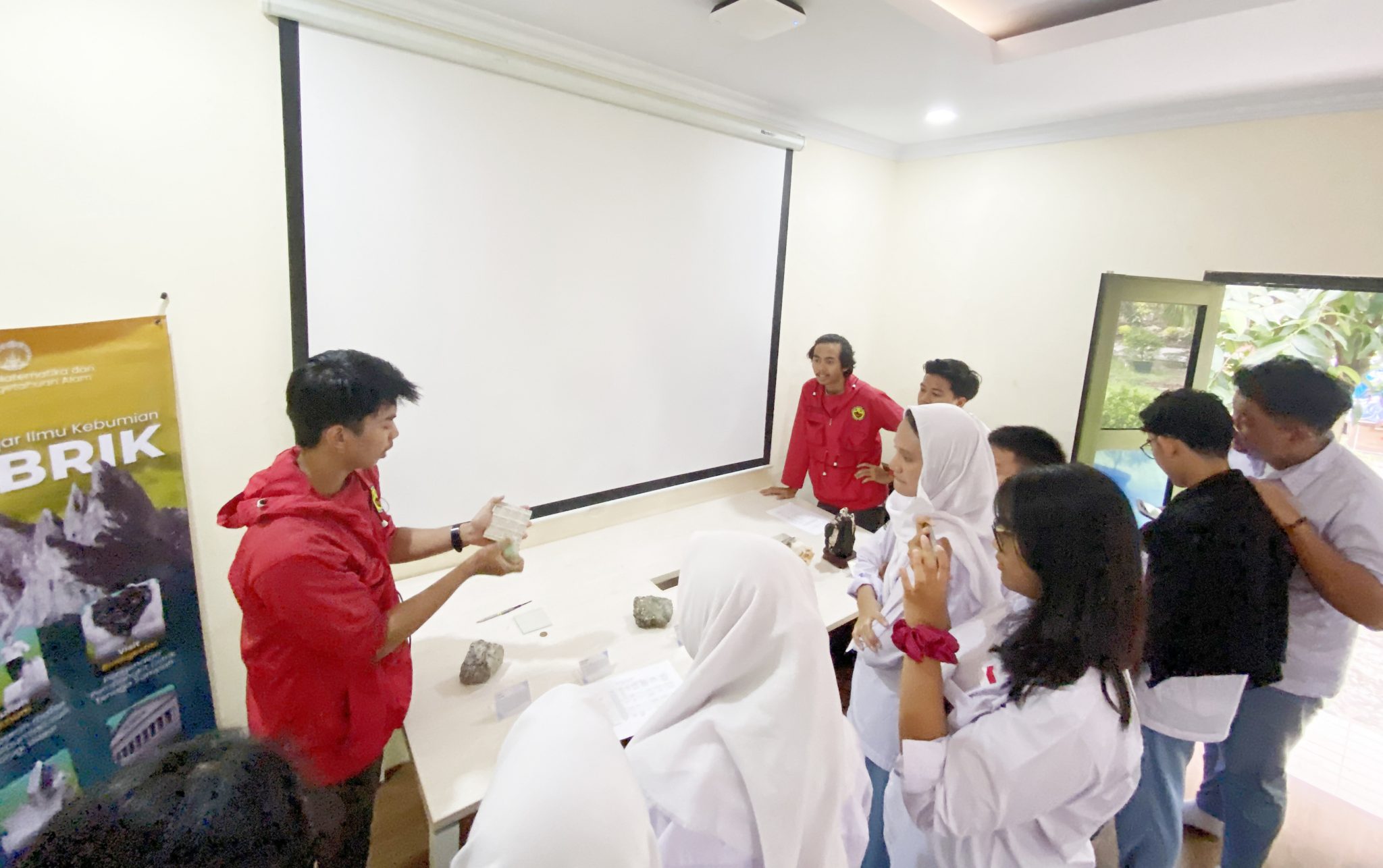
With the above background, a number of lecturers in the Geology Study Program (Prodi) of the Faculty of Mathematics and Natural Sciences, University of Indonesia (FMIPA UI) who are members of the Community Service (Pengmas) team held an activity entitled Earth Science Learning House, at the Parangtopo Laboratory, FMIPA UI, UI Depok Campus, on Monday, November 27, 2023.
Participants in this activity were students of class XI of SMA Negeri 1, Depok City, West Java. A total of 25 students participated in this educational and interesting activity.
"Our activities focus on direct introduction to various types of rocks that are common and often found in nature, as well as the dynamics of the earth's movement. So that students do not only learn from books, but can see and touch the rocks and minerals directly," said Reza Syahputra, Ph.D. as the head of the Geology Study Program and head of the FMIPA UI Community Service Team.

The activity method, continued Reza, is to play a game of identifying rocks in the mini museum at the Parangtopo Laboratory.
"This activity is expected to be an opportunity for students to be able to understand in depth the diversity of the earth's geology and its benefits, through the introduction of various types of rocks based on variations in their formation, as well as linking earth science theories with the reality around us," he said.
At the beginning of the activity, participants were invited to understand the dynamics of the earth's movement which is closely related to the movement of tectonic plates. Basically, the Earth is 4.5 billion years old and has survived various extreme weather conditions, starting from the condition of the Earth which has a CO content2 which was very high until the ice age. These extreme conditions resulted in mass extinctions of various types of living things. All natural disasters (volcanic eruptions and earthquakes) that wiped out many living things occurred due to the movement of tectonic plates in the continental and oceanic crust. The team also explained how the movement of these plates had a significant impact on the diversity of minerals and rocks on the earth's surface. As a result, the earth has diverse geological zones with unique rock compositions.
"To understand how the earth works, we can do it by observing the products of the geological process, one of which is rocks and minerals," Reza told the participants.
After the presentation, the activity continued by touring the mini rock museum at the Parangtopo Natural Laboratory to introduce various minerals and rocks to participants.

In addition to being educational, the mini museum at the Parangtopo Natural Laboratory is an interesting place for students to see various collections, as well as to identify minerals and rocks physically. Students are also given the opportunity to directly observe rock materials that have been sliced using a microscope.
In this activity, common rocks that the team introduced to participants include basalt, gabbro, granite, and pumice. Participants were also introduced to rocks that have economic value, such as coal, and valuable minerals such as chalcedony, quartz, and jasper. Not to forget, several types of minerals were also introduced, such as amethyst, pyrite, azurite, malachite.
This activity not only provides academic knowledge but also provides direct experience to students to deepen it. Thus, it is hoped that the younger generation will be more concerned, and motivated to further understand the complexity of the earth's geological diversity.
News source : https://sci.ui.ac.id/