|

The Department of Biology
Faculty of Mathematics and Natural Sciences Universitas Indonesia

The diversity of plant species owned by the Indonesian nation can provide great opportunities for bioprospecting in the field of bionanotechnology. Plants are one of the most potential nanoparticle biosynthesis agents, because they contain metabolite compounds that act as reducers and capping agent for the biosynthesis process of silver nanoparticles (NP Ag).
Plants are more effective nanoparticle synthesizing agents compared to other organisms. This is due to their ease of obtaining and extracting in large quantities. While the use of other biological agents such as bacteria, fungi or algae requires a lot of biomass and special maintenance conditions. In the process of NP Ag biosynthesis, bioactive compounds from plants that have antioxidant activity such as phenolic and flavonoid compounds are strongly suspected of acting as reducing agents.
With this background, Windri Handayani conducted research in her doctoral studies on the biosynthesis of silver nanoparticles as antibacterial materials with low toxicity levels. This research is a multidisciplinary research that covers the fields of biology, physics and chemistry. Overall, this research includes studies related to plant physiology, natural product chemistry, physics of materials science, and microbiology.
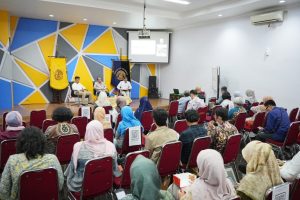
At the online promotion hearing for the FMIPA UI biology doctoral study program which was held on Thursday (6/1/2022), Windri successfully defended her dissertation entitled BIOPROSPEKSI Diospyros spp. (Ebenaceae) FOR SILVER NANOPARTICLE BIOSYNTHESIS AND ITS APPLICATION AS ANTIBACTERIAL MATERIAL in front of the board of examiners.
Through his dissertation, he explained that the biosynthesis method was chosen because it utilizes biological agents as an environmentally friendly source of reducing agents.
The research he conducted directly explored the use of extracts of 4 types Diospyros spp. in the biosynthesis process of silver nanoparticles.
"This group of plants has not been widely explored in terms of its potential use and is part of the bioprospecting of natural plant resources, especially in relation to the use of its bioactive compounds," explained Windri in her presentation to the examination team.
Nanoparticle biosynthesis itself is a method that can be used to produce nanoparticles that are target-specific, controlled, and have multifunctional capabilities, such as as catalysts in the chemical field, as antimicrobial materials in the health field, as sensor materials in the environmental field, and also in the agricultural field as nano-fertilizer.
"Therefore, the development of this method can minimize the use of toxic and hazardous chemicals, and utilize bioactive compounds from plants to become an interesting research focus to be carried out," he said.
Furthermore, he explained that in the biosynthesis process, it is necessary to regulate process parameters to obtain nanoparticles that have effective and optimal bioactivity. Plant preparation processes such as extraction processes and characterization of plant extracts need to be carried out to determine the bioactive compounds that play a role in the nanoparticle biosynthesis process.
According to him, the use of biological agents in nanoparticle synthesis opens up opportunities for bioprospecting and the use of natural biological resources. Plant resources still have many opportunities to be developed.
One of them is the potential of extracts from plants with certain bioactivities, whether as antimicrobial, anti-inflammatory, antioxidant, and what is currently being developed, namely as a synthesizing agent for nano-sized materials or for the functionalization of nano-materials.
Another use is to suppress the increase in resistance of pathogenic microorganisms to existing drugs and antibiotics.
He hopes that the results of his research can be a recommendation for the development of science related to the use of natural resources and phytochemical bioprospecting of diverse species. Diospyros spp., study of bioactive compounds, and their utilization for the synthesis of silver nanoparticles as antibacterial materials with low toxicity levels, as well as other potential applications.
Windri's success in pursuing education and research in this Doctoral study program cannot be separated from the guidance of Dede Djuhana, Ph. D. as the promoter, and Dr. rer. nat. Yasman, M. Sc., and Aminah, Ph.D. as Co-promoters.
News source : https://sci.ui.ac.id/