|

|
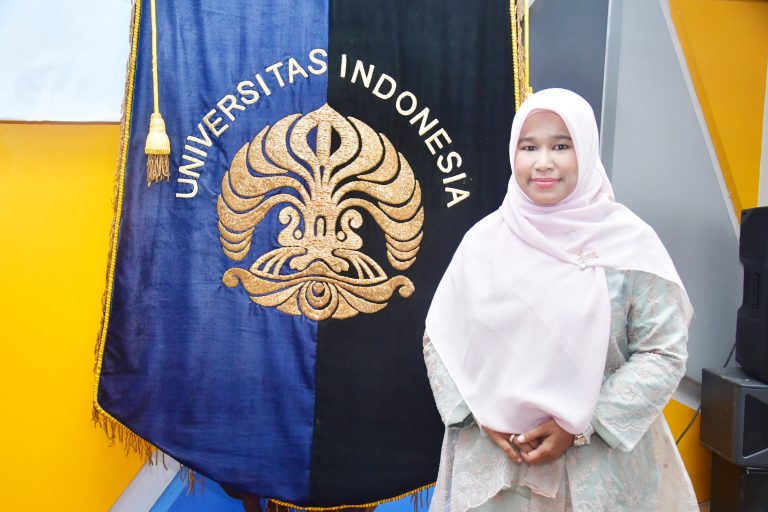
Depok, August 20, 2026 — The Faculty of Mathematics and Natural Sciences, Universitas Indonesia (FMIPA UI), continues to promote the development of innovative materials to address the challenges of clean energy technology. One such effort is the research conducted by Raihanaton, a doctoral candidate in the Chemistry Study Program at FMIPA UI, who developed lanthanum-based materials to address two needs simultaneously: hydrogen production and energy storage.
The innovation was developed using a lanthanum-based Metal–Organic Framework (MOF) with perylene ligands. The material was designed to support hydrogen production through water electrolysis while also serving as an electrode material for supercapacitors.
Raihanaton presented the research at the Doctoral Promotion in Chemistry at FMIPA UI, held at the Prof. Dr. G.A. Siwabessy Hall, FMIPA UI, Depok, on Monday (August 10, 2026). The research was presented in a dissertation entitled “Synthesis, Characterization, and Application of Lanthanum-Based Metal–Organic Framework with Perylene Ligands for Hydrogen Evolution Reaction (HER) and Supercapacitors.”
The development of this material is particularly relevant amid Indonesia’s efforts to accelerate the transition toward cleaner energy. Hydrogen, particularly green hydrogen, is receiving increasing attention as part of the development of low-emission energy solutions. At the same time, the need for energy storage technologies is becoming increasingly important as the use of renewable energy continues to expand.
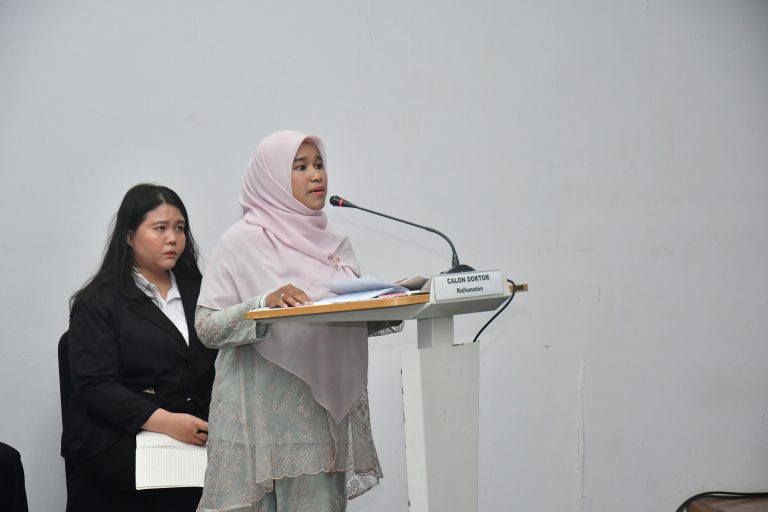
Through this research, FMIPA UI contributes to the development of materials that can support both of these needs. Raihanaton combined lanthanum ions with perylene-based compounds through a heating process at temperatures of 100, 120, and 170 degrees Celsius. These variations were carried out to determine the conditions that produce materials with the best characteristics and performance.
“This research was driven by the need to develop materials that serve more than one function. We sought to explore how a single material could be utilized to support both energy conversion and energy storage,” said Raihanaton.
The research results showed that the material synthesized at 170 degrees Celsius demonstrated the best performance. The material had a more ordered and uniform structure, enabling more efficient charge transfer.
To support hydrogen production, the material was used in the Hydrogen Evolution Reaction (HER), the reaction responsible for hydrogen generation during water electrolysis. Meanwhile, for energy storage, the same material was used as a supercapacitor electrode.
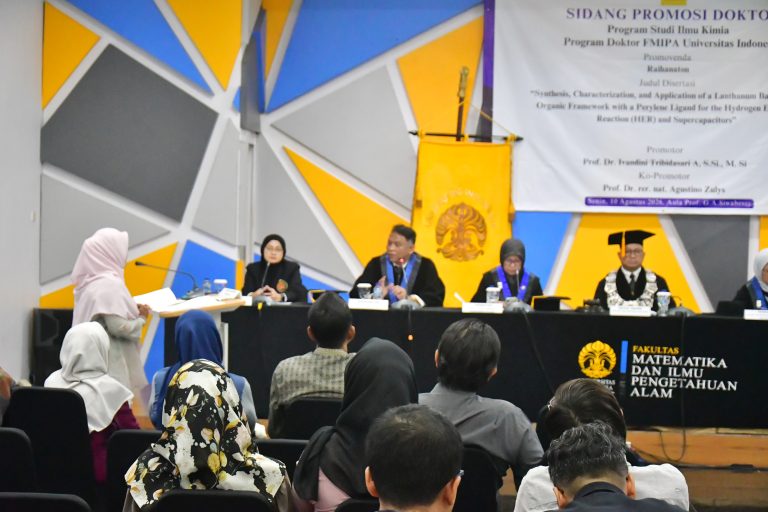
During HER testing in a 1 M KOH solution, the La–PTC material synthesized at 170 °C exhibited an onset overpotential of −302 mV and an overpotential of 722.7 mV at a current density of −10 mA cm⁻². The material also demonstrated good electrochemical stability.
For supercapacitor applications, the material achieved a specific capacitance of 175.5 F g⁻¹ at a current density of 0.5 A g⁻¹. After 3,000 cycles, the material retained 89.35% of its capacitance, with a Coulombic efficiency of 94%.
According to Raihanaton, these results demonstrate that the material synthesis method influences its ability to perform its intended functions. A synthesis temperature of 170 °C produced a material with characteristics that better support its electrochemical performance.
“Among the different synthesis temperatures tested, the sample synthesized at 170 °C exhibited the best performance. This finding demonstrates that controlling the synthesis conditions is essential for obtaining materials with optimal structure and performance,” said Raihanaton.
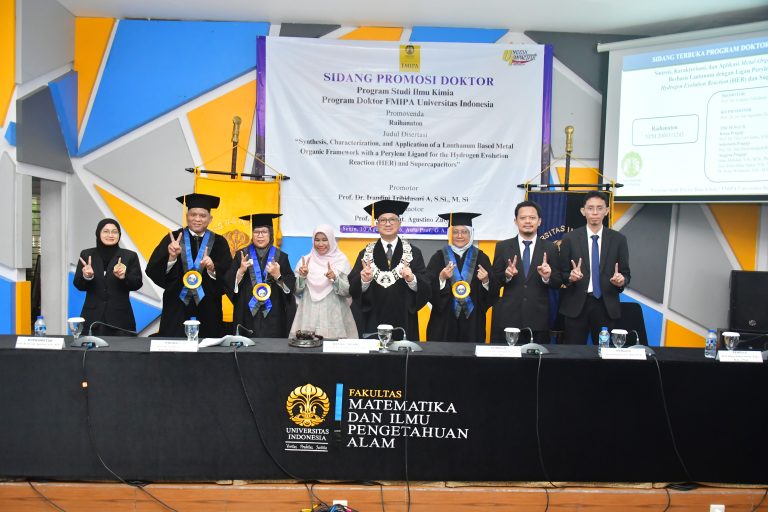
One of the novel aspects of this research is the use of a perylene ligand in lanthanum-based materials for dual applications. This approach enables the material to be studied not only for its potential to support hydrogen production but also as an energy storage material.
“The use of a perylene ligand in La-MOF for two applications, namely the Hydrogen Evolution Reaction and supercapacitors, is one of the novel aspects of this research. These findings could serve as a basis for developing multifunctional materials for future energy technologies,” said Raihanaton.
This research also highlights the role of materials chemistry research in addressing the needs of energy technologies. Through the development of multifunctional materials, FMIPA UI not only develops new materials but also explores their potential applications to support energy conversion and storage technologies.
Raihanaton’s doctoral promotion examination was chaired by Prof. Dr. Tito Latif Indra, S.Si., M.Si., Dean of FMIPA UI. The research was supervised by Promoter Prof. Dr. Ivandini Tribidasari Anggraningrum, S.Si., M.Si., from the Department of Chemistry, FMIPA UI, and Co-Promoter Prof. Dr. rer. nat. Agustino Zulys from the Department of Chemistry, FMIPA UI.