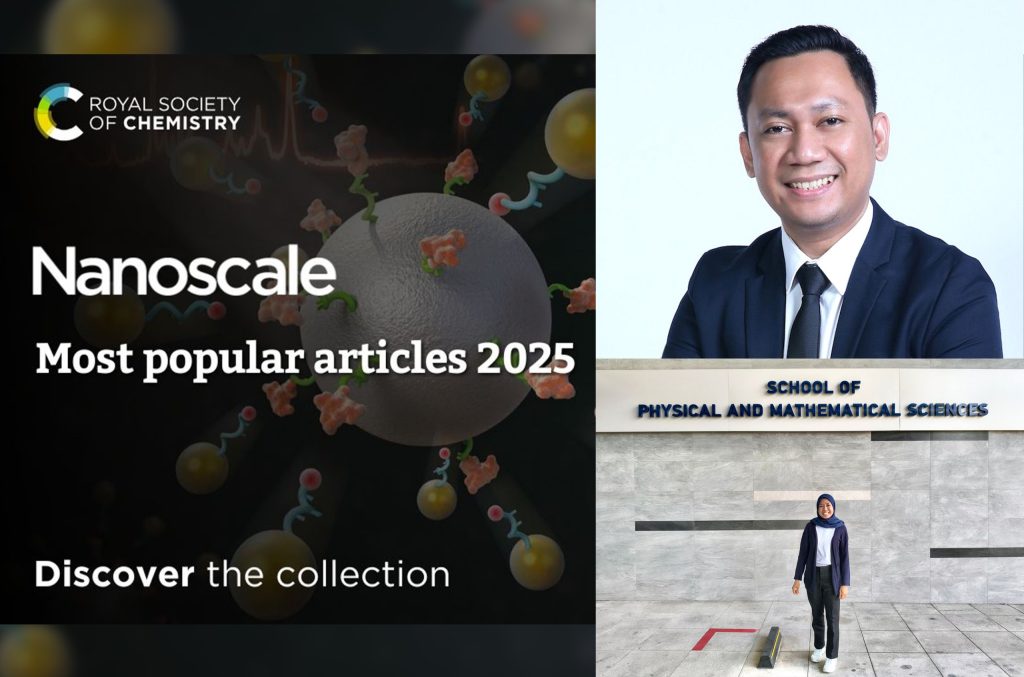
Depok, 9 February 2026 — The Faculty of Mathematics and Natural Sciences, Universitas Indonesia (FMIPA UI), has once again achieved global recognition through its research on the development of sensors for detecting pesticide residues in food. A research article by a lecturer from the Department of Chemistry, FMIPA UI, Dr. Munawar Khalil, entitled “Ultrasensitive Non-Enzymatic Electrochemical Detection of Paraoxon-Ethyl in Fruit Samples Using 2D Ti₃C₂Tₓ/MWCNT-OH,” has been selected as one of the Most Popular 2025 Articles in the journal Nanoscale, published by the Royal Society of Chemistry (RSC), United Kingdom.
The Most Popular Articles collection features articles that were the most read and downloaded throughout 2025. The selection of this article indicates that FMIPA UI’s research has attracted significant attention from the international scientific community.
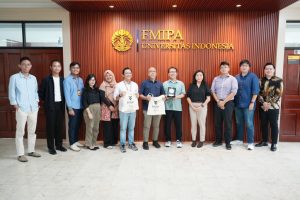
This research is the result of a cross-institutional collaboration involving FMIPA UI, IPB University (Institut Pertanian Bogor), the National Research and Innovation Agency (BRIN), and A*STAR Singapore. This collaboration enabled the use of advanced research facilities and facilitated the exchange of expertise across countries.
“This collaboration enriched the research perspective and helped maintain high research standards, from experimental design through to publication in a reputable journal,” Khalil said.
The research offers an innovative solution to support food safety, particularly for horticultural products. The developed sensor is capable of rapidly, stably, and accurately detecting pesticide residues, and is designed to be user-friendly and relatively cost-effective. This technology has the potential to be applied as a direct screening tool in traditional markets, distribution centers, and field monitoring activities.
“We directed this research to address real-world needs in the field, namely a sensitive and stable pesticide residue detection method that does not rely on enzymes,” said Dr. Munawar Khalil. According to him, the non-enzymatic approach makes the sensor more resistant to temperature and pH variations, while also being more cost-effective compared to enzyme-based sensors that are commonly used.
The research forms part of the master’s thesis of Asmi Aris, a graduate student in the Master’s Program (MSc) of the Department of Chemistry, FMIPA UI. The study focuses on the development of an electrochemical sensor based on a two-dimensional composite material consisting of MXene (Ti₃C₂Tₓ) and Multiwalled Carbon Nanotubes (MWCNTs). The combination of these materials was shown to enhance electrode conductivity and activity, enabling the sensor to detect the pesticide paraoxon-ethyl at extremely low levels, down to approximately 10 nanomolar.
Asmi revealed that the research process involved complex technical challenges, particularly during the synthesis of MXene materials. “The etching process of Ti₃C₂Tₓ involves hazardous chemicals such as HF, so it must be carried out with great care and in strict compliance with safety regulations. In addition, the relatively long synthesis time demands precision and consistency to ensure that the resulting material is truly suitable for sensor applications,” Asmi said.
Another challenge arose in determining the optimum composition of the Ti₃C₂Tₓ/MWCNT-OH nanocomposite. Differences in the characteristics of two-dimensional and one-dimensional materials affect the electrode’s surface area, conductivity, and functional groups. “The composition must be specifically tailored to the target analyte—in this case, paraoxon-ethyl—to ensure high sensitivity and selectivity of the sensor,” Asmi explained. She added that during real-sample testing, such as fruit samples, the complexity of the sample matrix also posed a separate challenge due to potential interference from other compounds.
Going forward, the research team plans to further develop the sensor to enhance its stability and efficiency, as well as to enable its application to a wider range of food samples. “We hope this technology can be used directly in the field and make a tangible contribution to food safety monitoring systems,” Asmi said.
This achievement further underscores FMIPA UI’s role as a research institution that actively contributes at the global level, with research that is not only scientifically excellent but also highly relevant to societal needs.