|

The Department of Biology
Faculty of Mathematics and Natural Sciences Universitas Indonesia
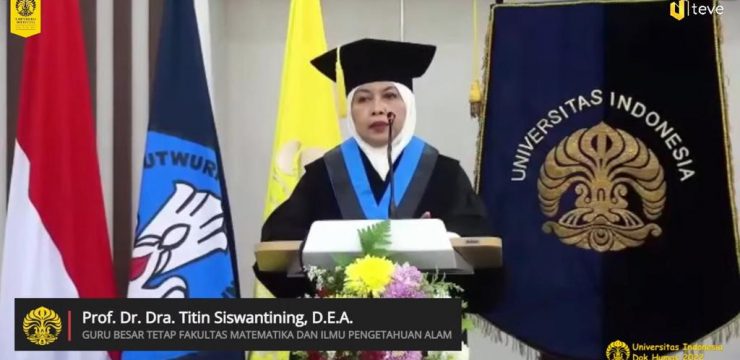
Depok, August 9, 2022. Statistics is a science related to data. In its development, statistics is used as a means to inform the decision-making process in dealing with uncertainty in the fields of science and humanities. This happens because statistics has the concepts of randomness, variability, error, and probability. Statistics has begun to develop into part of a combination of sciences such as data science and biostatistics.
Prof. Dr. Dra. Titin Siswantining, DEA, through her research entitled "The Role of Statistics in Data Science in Predicting Intelligence Healthcare Welcoming the Era of Society 5.0", revealed that data science emerged as a combination of science and social science. The sciences that are the main supporters in data science consist of mathematics, statistics, computer science, information systems, management, and communication science. Data science uses statistics to collect, review, analyze, and draw conclusions from data, and apply mathematical models that are measured to the appropriate variables.
Meanwhile, Society 5.0 is a concept that defines that technology and humans will live side by side in order to improve the quality of human life sustainably. Data science is the root of this technology. Its benefits can be felt in various fields, including health (healthcare). The role of statistics in healthcare is assisted by machine learning methods.
Machine learning merupakan bidang ilmu yang mengembangkan algoritma atau model yang dapat menggali pengetahuan dari data, sebagaimana proses belajar pada manusia. Machine learning dapat digunakan untuk menggantikan peran manusia terutama untuk data yang besar, kompleks, dan butuh respons yang cepat, seperti di dunia kesehatan.
Health phenomena involving technology and digitalization to record, process, and predict are called intelligent healthcare. In the use of statistics and machine learning in the health sector, it is highly recommended to ensure the state of the data, both ready to be processed and not. This is because the data found is often incomplete, unreadable, or outlier data, namely values that are too low or too high.
The form of application of machine learning in the health sector that is integrated with the process of care management, utilization, to accommodating the needs of the target population is covered in intelligent healthcare. The concrete role of statistics and data science is in the application of clustering, predicting, and imputation data methods. The data that will be inputted in the case of intelligent healthcare varies, ranging from microarray data, DNA chains, CT Scans, patient data, and protein interaction data.
Machine learning dibagi menjadi supervised learning, unsupervised learning, dan reinforcement learning. Penelitian bidang kesehatan menggunakan metode machine learning sub-bidang supervised learning, antara lain Classification of Diabetic Retinopathy Stages Using Histogram of Oriented Gradients and Shallow Learning (2018); Feature Selection Using Random Forest Classifier for Predicting Prostate Cancer (2019); Ovarian Cancer Classification Using Bayesian Logistic Regression (2019); Multiclass Classification of Acute Lymphoblastic Leukemia Microarrays Data Using Support Vector Machine Algorithms (2020); Kernel PCA and SVM-RFE Based Feature Selection for Classification of Dengue Microarray (2020); dan Covid-19 Classification Using X-Ray Imaging with Ensemble Learning (2021).
Meanwhile, research related to unsupervised learning is done through clustering, a method of grouping unlabeled data. Clustering has evolved into biclustering and triclustering. Biclustering is a data mining technique that allows grouping rows and columns of a matrix simultaneously. While tricluster is built from two data sets by selecting a subset of features from each data set and one subset of rows that are shared among all rows. Triclustering is an extension of the clustering and biclustering methods that work on three-dimensional data.
The study entitled "Triclustering Method for Finding Biomarkers in Human Immunodeficiency Virus-1 Gene Expression Data" reflects the role of statistics in data science in predicting intelligence healthcare in the era of society 5.0. In general, society 5.0 is a combination of IoT (Internet of Think), Big Data and AI (Artificiel Intellegence). Biostatistics is a tool in predicting Intelligence Healthcare of a patient in a hospital.
"We hope that in the future a research institution or incubator and a Biostatistics laboratory will be created in the FMIPA UI environment as a pioneer of Artificial Intelligence–Quality Improvement (AI-QI) in Indonesia to welcome the era of society 5.0 that we will face," said Prof. Titin.
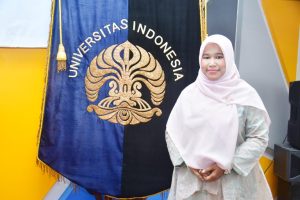
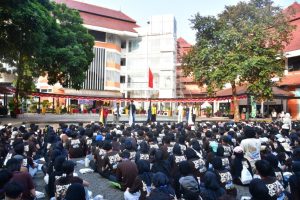
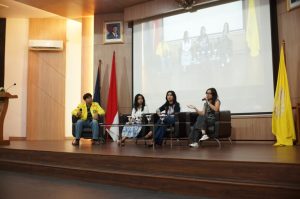
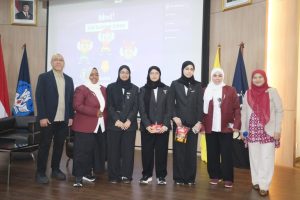
After the speech, Prof. Titin was officially inaugurated as a Permanent Professor of Statistics, Faculty of Mathematics and Natural Sciences (FMIPA), University of Indonesia (UI). The inauguration of the professor was led by the Chancellor of UI, Prof. Ari Kuncoro, SE, MA, Ph.D. and broadcasted live virtually through the UI Teve Youtube channel.
The event held on Saturday (6/8) was attended by invited guests, including the Commander of Iskandar Muda Military Command, Major General TNI Moh. Hasan; Head of the Social Welfare Data and Information Center, Prof. Dr. Agus Zainal Arifin, S.Kom., M.Kom.; Head of the PAK UI Adhoc Team, Prof. Heru Suhartanto, Drs, M.Sc., Ph.D.; UGM Professor, IndoMS Advisor, Prof. Dr. Sri Wahyuni, S.U.; CEO of Global Risk Management (GRM), Rinaldi Anwar, S.Si, MM, FSAI; Ph.D. Supervisor, Professor Queensland University of Technology (QUT), Australia, Prof. Dr. Kevin Burrage; Professor Perdana University (Malaysia), Prof. Mohammad Asif Khan, Ph.D.; UNPAD Professor, IndoMS Advisor, Prof. Dr. Budi Nurani Ruchjana, MS; Head of SAU UNAND, Prof. Dr. Syafrizal; and Professor of ITB, Indonesian Biomathematics Association, Prof. Edy Soewono, Ph.D.
Prof. Dr. Dra. Titin Siswantining, DEA is a Lecturer in the Department of Mathematics, FMIPA UI. She completed her studies in Statistics IS at the Sepuluh Nopember Institute of Technology Surabaya (ITS) in 1984; DEA en Mathematique Applique, EHESS – Universite de Paris V in 1990; and S3 Statistics from the Bogor Agricultural Institute (IPB) in 2013.
Several published scientific works, namely Pathway-Based Triclustering and Gene Onthology in Analyzing Gene Sample Time in Cancer Data (2022); Genomic Study with The Application of Triclustering Algorithm to Predict Chronic Diseases Using Machine Learning Method (2020/2021); Parallel Clustering Algorithms and Implementations for Big Data Analytic (2020/2021); Implementation of 3D Microarray Gene Expression Data using δ-Trimax, EDISA, and OPTricluster Algorithms (2020/2021); and Computer-Aided Diagnosis (CAD) for Early Detection of Diabetic Retinopathy (2020/2021).
News source : https://sci.ui.ac.id/