|

The Department of Biology
Faculty of Mathematics and Natural Sciences Universitas Indonesia
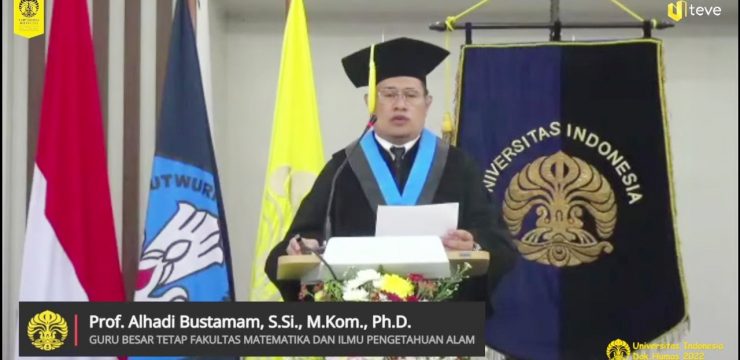
Depok, August 6, 2022. Progress in the Industrial Revolution 4.0 era has made all fields involve data digitalization, including the health sector. Data Science, which is a combination of mathematics, computers, and domain expertise, plays an important role in this. The existence of Data Science is one of the multidisciplinary sciences that is developing very rapidly and is applied as one of the solutions to form collaborations in the fields of science, industry, government, and other related fields.
Prof. Alhadi Bustamam, S. Si., M. Kom., Ph.D., in a study entitled "The Strategic Role of Computational Mathematics and Data Science in the Multidisciplinary Era of Bioinformatics, Big Data and Artificial Intelligence" sees the role of Computational Mathematics and Data Science for research in various fields. Computational mathematics is a branch of science to solve problems involving the management, processing and analysis of data computationally. Computational Mathematics is the main pillar of Data Science and its applications in the fields of Bioinformatics, Big Data, and Artificial Intelligence (AI).
Bioinformatics is an interdisciplinary field that focuses on the application of computational mathematics, statistics, and life sciences in managing and interpreting biological data. Currently, Bioinformatics is jumping into a new era of “big data” by producing big data in everyday life, such as in genomics research. Big Data itself is a collection of data that is very large, complex, and continues to grow all the time. Meanwhile, Artificial Intelligence (AI) or artificial intelligence is the ability of a system to interpret external data correctly, to learn from the data, and to use it to achieve certain goals and tasks through flexible adaptation.
Prof. Alhadi applies and implements Data Science, Big Data, and AI in the fields of telemedicine healthcare and entrepreneurship. In the field of telemedicine, development is realized through the creation of applications to detect diseases through eye fundus images; malaria detection through red blood cell images; dengue detection through red blood cell images and lab data; detection of Alzheimer's and Parkinson's disease through MRI images; and detection of cancer through image data and gene expression data.
In addition, detection is also carried out on heart disease through ECG signals; child stunting conditions through USG data; Tuberculosis disease; and Type-2 Diabetes Drug Candidates through molecular compound data with the QSAR approach. This research was further developed through collaboration with UMG IdeaLab, IMERI FK UI, RSCM, RSUI, and UI Advisory.
In the field of entrepreneurship, the role of computational mathematics through Data Science and AI is applied to several studies, including the detection of rice and rubber plant diseases through leaf images; development of insurance applications in terms of underwriting examinations in hospital administration; and development of models for smart cities. Research on the detection of rubber plant diseases through leaf images was conducted in collaboration with SATREP RIKEN Japan. The goal is to prevent rubber plants from being attacked by disease or even crop failure, with early detection through digital images obtained from satellites.
To detect diseases in rice plants, the research collaborated with BRIN LAPAN. Rice plant diseases such as tungro which originate from viruses, fungi, and bacteria can inhibit rice production in Indonesia. Rice plant leaves affected by disease can be used as an indicator of the type of disease because each rice plant disease has a unique pattern on the leaves of the rice plant. Disease detection in rice plants is carried out through images of rice plant leaves.
Meanwhile, in the field of entrepreneurship related to insurance and chatbots, research was conducted with URIMO-Life. The insurance offered by URIMO-Life contains elements of Bioinformatics, Data Science, and AI because in addition to checking the health condition of the insured, researchers also calculate premiums based on the patient's biological age.
Prof. Alhadi sees prospects in the development of research related to Computational Mathematics, Data Science, Bioinformatics, Big Data and AI in the multidisciplinary era. Prospects for developing research include research collaboration with related faculties/fields, government, and industry; MBKM Program and introduction of Data Science and AI at school level; strengthening human resources; and the formation of startups in the field of Data Science and AI. In addition, this field of science also has a major role in the development of research in the fields of life science, health and entrepreneurship through collaboration between disciplines, such as Mathematics, Biology, Pharmacy, Medicine, Chemistry, and Computer Science, and others.
After the speech, Prof. Alhadi was officially inaugurated as a Permanent Professor of Computational Mathematics, Faculty of Mathematics and Natural Sciences (FMIPA), University of Indonesia (UI). The inauguration of the professor was led by the Chancellor of UI, Prof. Ari Kuncoro, SE, MA, Ph.D., and broadcasted live virtually through the UI Teve Youtube channel.
Prof. Alhadi Bustamam, S. Si., M. Kom., Ph.D. is a Lecturer and Head of the Department of Mathematics, FMIPA UI. He completed his undergraduate studies in Mathematics, FMIPA UI in 1996; his Masters studies in Computer Science, Fasilkom UI in 2002; and his Doctoral studies in Advanced Computing in Bioinformatics from School of Mathematics and Institute for Molecular Bioscience, The University of Queensland (UQ), Australia in 2011.
Some of the latest scientific works that have been published include Development of Artificial Intelligence Analysis to Assess Meibomian Gland Dysfunction (MGD) in Dry Eye Disease Using Meibography Imaging (2022); Genomic Sequence Analysis on Covid-19 and Other Infectious Diseases using the in Silico Approach and Big Data Analytics (2022); Genomics Analysis on Multimodal Data for Detection of Dengue Fever (DHF) and Chronic Diseases using the Feature Selection Fusion Approach (2022); and Implementation and Application of AI and Chatbot for Intelligent Healthcare (2021).
News source : https://sci.ui.ac.id/