|

The Department of Biology
Faculty of Mathematics and Natural Sciences Universitas Indonesia
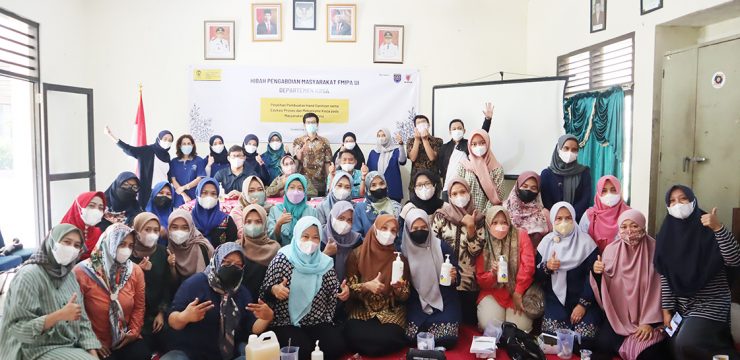
The Faculty of Mathematics and Natural Sciences, University of Indonesia (FMIPA UI) through the Department of Chemistry provided training and education to residents of Pondok Cina Village on the process of making and how alcohol-based hand sanitizers work, on Sunday (24/7) at the Pondok Cina Village Hall, Depok. The activity is an implementation of the community service program (pengmas).
Head of the Chemistry Department Asep Saefumillah, M.Sc., Ph.D. explained that this community service program is a form of concern from the Chemistry Department of FMIPA UI in implementing the Tri Dharma of Higher Education. The purpose of implementing the community service is to provide insight and provide knowledge to residents about the process of making effective hand sanitizers independently and how it works to kill virus particles.
"So, the goal is that when a pandemic occurs again in the future, participants will have the knowledge on how to make effective hand sanitizers independently," said Asep, who is also a lecturer at FMIPA UI with expertise in Analytical and Environmental Chemistry.
In this activity, the Chemistry Department provides complete facilities in the form of equipment and materials needed. The tools and materials provided include a container in the form of a 1 L glass, spatula, hand blender, 50 grams of gel, 400 ml of ethanol, 80 ml of water, and 2 ml of fragrance.
Accompanied directly by the head of the community service team Dr.rer.nat. Agustino Zulys M.Sc., the activity involving 30 participants went smoothly and pleasantly. The team leader explained the process of making hand sanitizer which began by putting the gel into a container, then mixing 200 ml of alcohol. All ingredients are mixed evenly using a hand blender until they become a homogeneous mixture.
The next process is to add and mix the water and remaining alcohol. Finally, the team recommends adding fragrance to the mixture of ingredients so that the resulting hand sanitizer not only smells of alcohol but also has a distinctive aroma.
"That way, all of you ladies can use the hand sanitizer that has been made," said the team leader, Dr.rer.nat. Agustino Zulys M.Sc.
Before the training begins, the community must first fill out a form pre-test to measure participants' knowledge about hand sanitizers.
Dr. Munawar Khalil, gave a presentation on the definition, how it works, usage, materials and uses, and the process of making hand sanitizer.
He explained that hand sanitizer is a practical hand cleaning fluid that can be used anywhere to inhibit or kill microorganisms in living tissue.
There are two types of hand sanitizers commonly used, namely those containing alcohol and those without alcohol.
“Hand sanitizers containing alcohol usually use compounds etanol, iso-propanol, and n-propanol as an active ingredient. While those that do not contain alcohol usually use compounds ammonium kuartener, benzalkonium klorida, chlorhexidine, iodine, and triclosan as an active ingredient," said the Director of Research and Development at UI.
Alcoholic hand sanitizer according to recommendations World Health Organization (WHO) requires a concentration of 70% which has been dissolved with other chemicals.
"That means, 70% of this has been dissolved with perfumed water, and the like, the alcohol content must be 70%. No more and no less. If the concentration of the content is more than or less than 70%, the effectiveness of the hand sanitizer is reduced in killing viruses," he added.
Dr. Munawar appealed to participants to use hand sanitizer properly. Starting from the surface of the palm and the back of the hand, spreading it evenly over the entire hand to the spaces between the fingers, and most importantly letting the hand sanitizer dry for 20-30 seconds before continuing the activity.
Meanwhile, hand sanitizers made from ethanol and alcohol require special attention so as not to trigger work accidents that can harm yourself and others. Dr. Munawar reminded of the dangers of ethanol liquid if due to someone's negligence in using it.
"Ethanol is a flammable liquid. Therefore, keep ethanol away from sparks. And if ethanol comes into contact with the eyes, the impact can cause eye irritation," he said.
Another thing that participants need to know about hand sanitizers is how they work. The FMIPA UI inorganic chemistry expert explained how hand sanitizers work as follows, first of all when the corona virus particles stick to the surface of the skin, the virus membrane melts with the human membrane cells, the virus then reproduces itself in the human body, the function of alcohol in this case works to break down the virus envelope, so that the RNA virus in the virus envelope is separated & destroyed. Finally, the microorganism which in this case is the virus does not develop and dies. Before the event closed, residents were asked to refill post-test untuk mengukur sejauh mana ilmu yang disampaikan dapat dipahami.
Residents of Pondok Cina Village were very enthusiastic about participating in the three-hour training. Head of the Economy and Development Section of Pondok Cina Village, Desi, welcomed the team's presence. According to her, the scope of this activity has great potential to be expanded.
The Chemistry Department plans to hold two other community service activities. The two community services that will be held later are education on the importance of nutritional intake and food metabolism processes, as well as socialization of competency improvement for teachers.
News source : https://sci.ui.ac.id/