|

|
Natural fibers derived from plants are numerous, including hemp, straw, wood, rice husks, barley, wheat, rye, grass, cogongrass, kenaf, empty oil palm fruit bunches, sisal, coir, water hyacinth, kapok, mulberry paper, raphia, banana fiber, pineapple leaf fiber, and papyrus.
Among these natural fibers, bamboo fiber is one of the most promising, due to its strength and stiffness, low density, economy, short growth cycle, and high availability.
Bamboo fiber has the potential to be an alternative or substitute for synthetic fibers due to its superior mechanical properties (tensile strength reaches 710 MPa), competitive price, environmental friendliness, abundant availability in Indonesia (120 species), short harvest period (4-5 years), and low density (0.8 g/cm3).3 ).
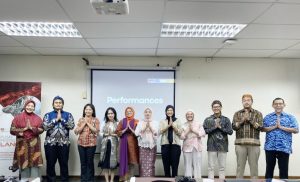
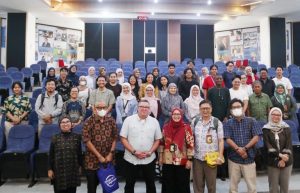
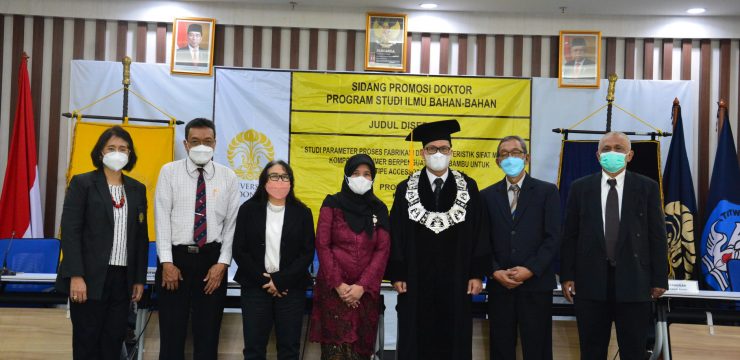
Martijanti explained this during the open promotion session for the Doctoral Program in Materials Science at the Faculty of Mathematics and Natural Sciences, University of Indonesia, held on Thursday (April 7, 2022) in the auditorium of the Multidisciplinary Research Laboratory Building, Faculty of Mathematics and Natural Sciences, University of Indonesia, Depok.
The superiority of bamboo fiber is the basis for her research to develop natural fiber-based materials as a substitute for synthetic fibers.
He put the results of his research into his dissertation entitled "Study of Fabrication Process Parameters and Mechanical Properties Characteristics of Bamboo Fiber Reinforced Polymer Composites for Prototype Accessories automotive
In his dissertation summary, he explained that the research he conducted was to develop and optimize the alkalization process parameters and characterization of fibers and fabrication of bamboo fiber composites with polymer matrices for applications. accessories otomotif.
"This research is divided into three stages using an experimental method. The first stage involves the alkalization process, varying the concentration, temperature, time, and type of bamboo. The second stage involves producing bamboo fiber from two selected bamboo species as raw materials for composite fabrication. The third stage involves composite fabrication and product characterization. accessories automotive, then compared with the SNI 03 – 2105 – 2006 standards and products accessories automotive products on the market,” Martijanti explained her research method before the chair of the session and the examination team.
Furthermore, he said that the results of his research could be a recommendation for polymer composite materials (polypropylene) reinforced with bamboo particles as an alternative or replacement for composite materials reinforced with synthetic fibers (glass fibers) or pure polymer materials that can be applied to particle boards such as panel boards or automotive accessory products, namely cover engine motorcycle
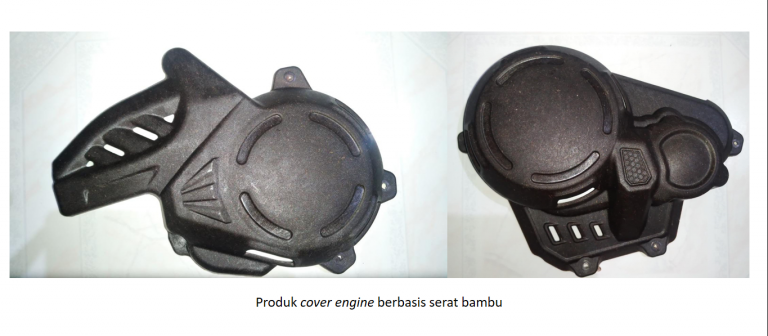
The research successfully met the particleboard standard (SNI 03-2105-2006) and the requirements for engine cover products currently available on the market, made from pure polypropylene.
The Technology Readiness Level (TKT) of the research results is an assessment that describes technological readiness on a scale of 1 to 9, each level being interconnected and serving as the basis for the next level.
The TKT regulation for research results was issued by the Ministry of Research, Technology, and Higher Education, namely Regulation of the Minister of Research, Technology, and Higher Education Number 42 of 2016. If the TKT measurement is carried out on a scale of 1 to 9, the results of this research activity can be classified as TKT 6, namely: the model or prototype has been tested in a relevant environment.
This research result was then further developed to achieve TKT 8 and is being pursued for mass production in collaboration with industry. This research product has even successfully substituted the engine cover's raw material composition, which is made from 100% pure polypropylene, with 30% bamboo particles and 70% polypropylene, at a competitive price. The advantage of products made from polypropylene-bamboo particle composites is that they are made from more environmentally friendly materials and are stronger.
During her research, this mother of three received support from industry, who were also her collaborators, in the form of inkind He expressed his gratitude and appreciation to these supporting parties.
For her achievements, Martijanti earned a Doctorate with a Very Satisfactory predicate under the guidance of Dra. Ariadne L. Juwono, M.Eng., Ph.D. as promoter and Dr. Ir. Sutarno, MT. as Co-Promoter. The lecturer at Jenderal Achmad Yani University successfully completed her Doctoral studies in 5 years.
News source : https://sci.ui.ac.id/