|

|

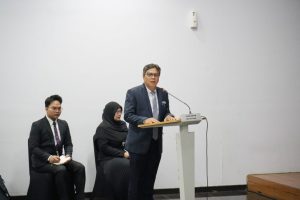
Amarasinghe Achchige Thasun successfully earned a Doctorate degree in the Postgraduate Program in Biology, Faculty of Mathematics and Natural Sciences, University of Indonesia (FMIPA UI). At the open session for doctoral promotion held on Thursday, January 4, 2024 at the G.A. Siwabessy Hall, FMIPA UI, Depok, Thasun, his nickname, delivered a dissertation entitled "The Effect of Island Isolation on the Morphology, Evolution, and Biogeography of the Genus Bronchocela Kaup, 1827 (Reptilia: Agamidae) in Indonesia”. Isolation is a major factor in island biogeography. In his research, Dr. Thasun tries to understand this phenomenon.
Through his dissertation, he revealed the phylogeographic phenomenon of the chameleon group from the Agamidae family which is spread across Southeast Asia, namely the genus Bronchocela in the Indonesian Archipelago based on morphological data (skull size), molecular (mitochondrial and nuclear DNA), and evolutionary data.
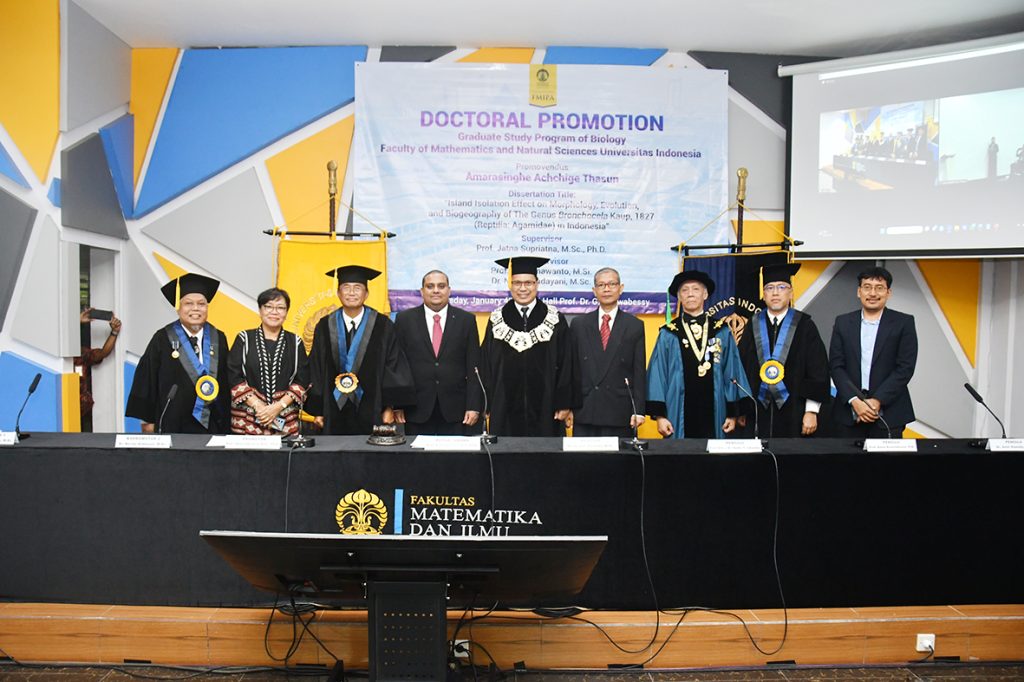
This research on chameleons is the first research that is equipped with all aspects of external morphology, skull, molecular studies with many genes, and evolutionary and biogeographic analysis approaches that cover the entire Indonesian archipelago.
Bunglon genus Bronchocela is known to have a wide distribution area, starting from the Southern Greater Sunda region to Papua New Guinea. Complex morphological variations in this fragmented genus in the Indonesian archipelago make it difficult to determine species boundaries clearly.
“Therefore, based on molecular phylogenetics, we made potential biogeographic boundaries of this species composition. The reconstruction of the phylogenetic tree was carried out based on two mitochondrial DNA genetic markers (16s rRNA and ND2), with the intervention of nuclear DNA loci (CMOS) indicating the presence of six evolutionary lineages. Bronchocela in Indonesia and in this study it was proven B. cristatella which is widely distributed as a species complex consisting of at least three different species,” Dr. Thasun told the examiners.
He continued, estimates of population structure and gene flow across the Sunda region and the Greater Sunda Islands indicate total isolation unless there is a land bridge (land bridge) which connected the two regions during the maximum glacial period.
Genus Bronchocela cosmopolitan, highly variable morphology scattered and isolated in fragmented forests in the Indonesian Archipelago. The complex variation in this genus makes it difficult to determine the species boundaries clearly. Thasun revealed that as many as 520 individual specimens from museum collections have been examined to test the impact of geographical island isolation on the morphological structure of the population. Statistical tests were carried out using univariate and multivariate analysis.
"So far, only four species have been identified in the Indonesian region, after conducting this research, at least six species have been identified," he said.
The results of the BEAST analysis show that Bronchocela originated about 42 million years ago on the Asian mainland and is a basal clade Bronchocela terdiri dari B. burmana whose ancestral taxa are largely restricted to Peninsular Malaysia. The results of the maximum clade credibility (MCC) analysis indicate that the genus Bronchocela evolved in the early Miocene (~18.7 million years ago) and began rapid speciation in the late Miocene.
This study also shows that larger islands support the life of large-sized chameleons compared to smaller islands (island dwarfism phenomenon) and is in line with the theory of island isolation.
Thasun's success in pursuing education and research in this Doctoral study program cannot be separated from the guidance of Prof. Jatna Supriatna, M.Sc., Ph.D. as the promoter and Prof. Dr. Abinawanto, M.Sc. and Dr. Noviar Andayani, M.Sc. as Co-promoters.
Prof. Jatna Supriatna, M.Sc., Ph.D. explained that Indonesia is a country with very large biodiversity wealth, both on land and in the ocean. This condition is certainly supported by Indonesia's geographical position which consists of islands with varied and unique characteristics.
This study, said Prof. Jatna, shows how island isolation affects the external and internal morphology of a population, genetic makeup, biogeographic adaptations such as body size variation, and ultimately evolution and diversity into separate species.
"Because this species is a habitat specialist, this species is a very potential bioindicator species for assessing forest quality. This study also shows that Pliocene climate change can have a major impact on species diversification and demography of forest species in the Indonesian archipelago," said Prof. Jatna.
Also present at the open session of the doctoral promotion were Sri Lankan Ambassador to Indonesia Admiral Prof. Jayanath Colombage, Vice Dean for Education, Research, and Student Affairs of FMIPA UI Prof. Dr. rer. nat. Budiawan, Vice Dean for Resources, Ventures, and General Administration of FMIPA UI Dr. Tito Latif Indra, M.Si, and Director of Forest Prevention and Security of the Ministry of Environment and Forestry Dr. Ir. Sustyo Iriyono, M.Si.
About Dr. Amarasinghe Achchige Thasun
Dr. Thasun was previously a citizen of the Democratic Socialist Republic of Sri Lanka. He was born on November 22, 1984 in Colombo, Sri Lanka. He first came to Indonesia in 2010 to attend the ATBC symposium held by UI and LIPI in Bali. He then joined the ATBC field course program 2010, and began conducting research in Alaspurwo National Park, Baluran National Park, Rinjani National Park, and Bedugul Botanical Garden.
In that activity, Dr. Thasun met Niki Kurniawati for the first time who was also a participant in the field course activity. Niki is a graduate of the Biology study program, FMIPA UI. The two then married in 2016. In the same year, Dr. Thasun officially changed his citizenship to become an Indonesian Citizen (WNI).
He chose to study in the Biology Postgraduate Program at FMIPA UI, because of his high motivation to understand more about biogeography, and animal evolution in Indonesia. Moreover, said Dr. Thasun, Indonesia is one of the countries that has a high level of biodiversity, not much different from the diversity of the Western Ghats hotspot in Sri Lanka.
He expressed his desire to disseminate his knowledge and research experience to the public, especially students.
“My deepest ambition is to be able to share my knowledge and experience with the next generation of students and prepare them to have international standard skills,” said Dr. Thasun.
As an Indonesian citizen, he is committed to serving the Indonesian state to continue and develop research in his field, as a form of his contribution to maintaining biodiversity in Indonesia.
News source : https://sci.ui.ac.id/