|

The Department of Biology
Faculty of Mathematics and Natural Sciences Universitas Indonesia
Depok, June 5, 2026 – The Faculty of Mathematics and Natural Sciences, Universitas Indonesia (FMIPA UI), is promoting the use of Internet of Things (IoT) technology and greenhouse gas emission monitoring to help address the decline in rice and corn productivity in Jombatan Village, Kesamben District, Jombang Regency, East Java.
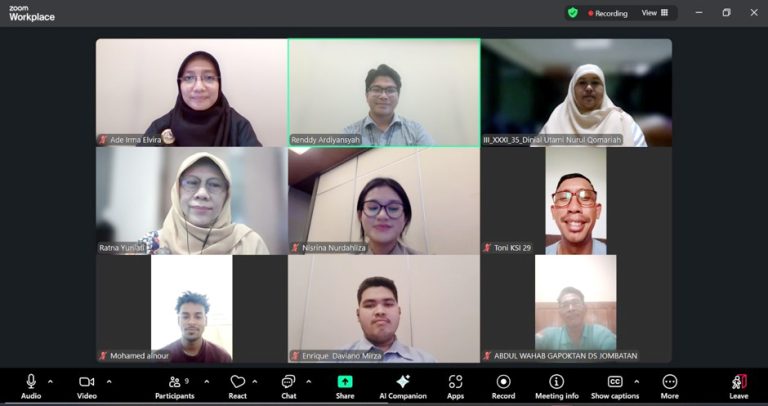
The initiative was carried out through a community engagement program that began with a Focus Group Discussion (FGD) entitled “Implementation of IoT and Greenhouse Gas Emission Monitoring for Rice and Corn Productivity in Jombatan Village, Kesamben District, Jombang Regency, East Java,” held on Monday, April 27, 2026.
The program was initiated in response to the decline in agricultural productivity experienced by farmers in recent years. This situation has not only affected farmers’ incomes but also poses a potential threat to local food security in the region.
According to Ade Irma Elvira, Head of the Community Engagement Team from the Department of Biology, FMIPA UI, farmers traditionally cultivated crops twice a year before 2023 using planting patterns such as rice–rice–fallow or rice–rice–corn. During that period, rice and corn yields could reach between 8 and 10 tons per harvest.
However, after the planting pattern shifted to three rice-growing cycles per year, productivity declined significantly to approximately 3 to 6 tons per harvest. In some areas, farmers even experienced crop failures.
“Through this forum, we aim to hear directly from farmers about their experiences and the challenges they face, so that the solutions we develop are grounded in real conditions in the field,” said Dr. Elvira.
The FGD brought together academics and researchers from various institutions, including Ratna Yuniati from FMIPA UI and Dinial Utami Nurul Qomariah from Politeknik Negeri Jember. The forum was also attended by students from the Biology Study Program at FMIPA UI and representatives of farmers from Jombatan Village.
Abdul Wahab, Chair of the Farmers’ Group Association (Gapoktan) of Jombatan Village, stated that the decline in crop yields has become a serious concern for local farmers.
“Since participating in the government program, our rice productivity has declined from around 8 tons to as low as 3 tons per harvest, and in some cases, fields have produced no yield at all,” he said.
Based on the research team’s preliminary analysis, the decline in productivity is suspected to be linked to changes in the soil’s physical and chemical properties. Long-term use of chemical fertilizers is believed to have affected soil structure, preventing organic matter from decomposing efficiently into the nutrients required for optimal plant growth.
In addition, inadequate drainage conditions have led to excessive soil moisture and a decline in soil pH levels. These conditions are believed to inhibit the activity of microorganisms responsible for decomposing organic matter, resulting in a gradual decrease in soil fertility over time.
Another factor of concern is the growing impact of climate change, which is increasingly being felt by farmers. The combination of these challenges is feared to not only reduce agricultural productivity but also threaten local food security in the community.
As an initial step, the FMIPA UI research team will conduct soil sampling at several rice field locations in Jombatan Village on June 8, 2026. The activity will involve farmers, local community members, and village officials.
The collected samples will be analyzed to determine soil characteristics, pH levels, nutrient content, and various factors affecting crop productivity. The results of this analysis will serve as a basis for developing land management recommendations and implementing technologies that are appropriate to local conditions.
Next, the team will install IoT sensors to monitor soil pH and moisture levels in real time. These two parameters were selected because they are key indicators believed to be associated with the decline in productivity in Jombatan Village.
Data collected from the sensors can be accessed by farmers via mobile phones, allowing them to monitor field conditions regularly. Meanwhile, greenhouse gas emission measurements will continue to be conducted as part of the research, although the results cannot be directly monitored by farmers in real time.
Dr. Elvira stated that the implementation of this technology is expected to help resolve 50 to 80 percent of the challenges faced by farmers. In the long term, crop productivity is targeted to return to 8 to 10 tons per harvest, even with a three-cropping-per-year planting pattern.
“We want to ensure that the research results and innovations we develop do not stop at the laboratory stage, but can be utilized by farmers to increase productivity while also maintaining environmental sustainability,” she said.
FMIPA UI selected Jombatan Village as the program site because the area has extensive rice and corn farmland, but is currently experiencing a significant decline in agricultural productivity.
As a follow-up to the discussion, the research team together with farmers and stakeholders will conduct a community service program on June 9, 2026, in the agricultural fields of Jombatan Village. This activity will mark the direct field implementation phase of IoT technology.
This program also involves students as part of their learning and community engagement activities. Biology students from FMIPA UI will assist in providing education and demonstrations on the use of IoT devices and chamber equipment for greenhouse gas measurement to farmers. In addition, international students from Syarif Hidayatullah State Islamic University Jakarta also participated in supporting the field activities.
Dr. Elvira hopes that this program will continue even after the community service activities are completed, so that the soil analysis results and field data obtained can serve as a foundation for developing long-term solutions for farmers.
“The success of this program is not only measured by the implementation of technology, but also by the extent to which the technology can be understood, accepted, and sustainably utilized by farmers to improve their welfare,” said Dr. Elvira.