|

The Department of Biology
Faculty of Mathematics and Natural Sciences Universitas Indonesia
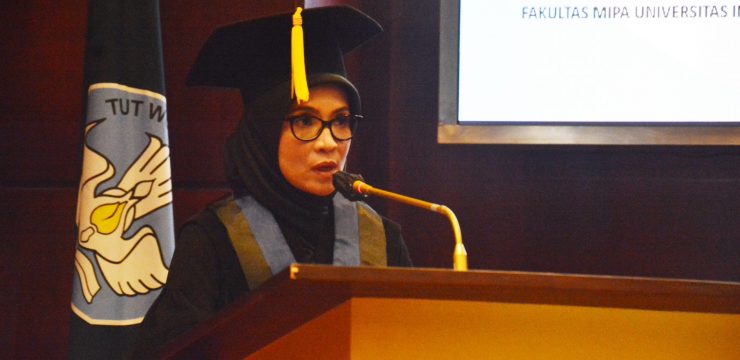
Depok, December 15, 2022. Three of the many problems often faced by developing countries are health and welfare issues, the availability of clean water and proper sanitation, and affordable clean energy. In fact, these three problems have been agreed upon by the UN to be addressed together under the umbrella of the 2030 Agenda for Sustainable Development Goals or often referred to as the Sustainable Development Goals (SDGs). To achieve these seventeen SDGs by 2030, of course, partnerships between developing and developed countries are an absolute requirement.
However, initiatives from developing countries, especially from their scientists, are critical factors, determining the success of these SDGs. When delivering her inaugural speech as a professor at the University of Indonesia (UI) (Wednesday, 12/14), Prof. Dr. Vivi Fauzia, S.Si., M.Si., a lecturer from the Faculty of Mathematics and Natural Sciences (FMIPA) UI, said that the field of nanomaterials which is the basis of her research contributes to the fields of health, clean water availability, and renewable clean energy.
The first nanomaterial developed by Prof. Vivi Fauzia in the UI Physics laboratory is made from precious metals such as gold, silver, platinum, and palladium. These precious metals exhibit localized surface plasmon resonance (LSPR) effects. LSPR is related to the increase in the intensity of light absorption and scattering on the surface of metal nanoparticles, and depends on the size, shape, composition, distance between nanoparticles, and also the dielectric properties of the surrounding medium.
The results of laboratory experiments confirm this; the addition of Au nanoparticles successfully increases light absorption, the mobility of active material charges, and the separation of excitons, which ultimately can increase the efficiency of solar cells to be higher. In the health sector, Prof. Vivi said that the LSPR effect of Au nanoparticles can also be used to detect dangerous preservatives in food formaldehyde, or often called formalin.
These Au nanoparticles are added in an optical sensor that works with a color change mechanism when interacting with formalin. The new design of optical biosensors that was successfully made using Au nanoparticles, alcohol oxidase enzymes, and dyes, showed very good performance, because the LSPR effect as a nano antenna provides more light for color changes to occur.
"Another nanomaterial studied is the semiconductor type ZnO nanorods, which is developed as a photocatalyst, which is a material that can increase the rate of chemical reactions with the help of light. With exposure to light, highly reactive ions are produced, which can damage dyes in wastewater contaminated with dyes, into a colorless and harmless form," said Prof. Vivi explaining her research related to the availability of clean water.
According to Prof. Vivi, another application of ZnO is as a photoanode in a water splitting system to obtain clean hydrogen H2 energy. This research supports the search for alternative materials in the exploration of environmentally friendly and commercially viable fuels. In the photoelectrochemical water splitting (PEC) method, the energy needs for water splitting are supplied from the abundant sunlight in Indonesia.
Together with her students, Prof. Vivi Fauzia developed ZnO/MoS2 heterostructure as PEC photoanode through two MoS2 deposition methods. The first method using exfoliated commercial MoS2 powder showed that the addition of MoS2 resulted in an increase in efficiency of more than two times. The second method through direct growth of MoS2 on ZnO using hydrothermal resulted in very profitable results, because the ternary heterostructure ZnO/ZnS/MoS2 was formed which could increase efficiency up to six times.
Another application of MoS2 material is in the photothermal system to obtain clean water. This system is an innovation of conventional distillation technology which is inefficient due to the low evaporation rate. The use of photothermal material, which is a material that can convert sunlight into heat, can increase the evaporation rate of seawater or wastewater to obtain clean water according to the standards set by WHO.
After delivering his speech, UI Chancellor, Prof. Ari Kuncoro, S.E., M.A., Ph.D., who led the open session for the inauguration of three professors from the Faculty of Mathematics and Natural Sciences, FMIPA, inaugurated Prof. Vivi as a permanent professor in the Field of Materials Science, Department of Physics, FMIPA UI. The event, which was broadcast virtually through the UI Youtube channel and UI Teve, was attended by various invited guests, including Professors from the University Kebangsaan Malaysia, Prof. Dr. Muhamad Mat Saleh and Prof. Dr. Muhammad Yahaya; Professor of the Department of Physics, IPB University, Prof. Dr. Husin Alatas; President Commissioner of Citilink Indonesia, Prof. Dr. Prasetio; and President Director of Citilink Indonesia, Dewa Kadek Rai.
Currently, Prof. Vivi serves as Head of Registration Sub-Directorate of Education Directorate UI 2022-present. She completed her undergraduate studies in Physics, at the Bandung Institute of Technology in 1995. Then at the same university in 1997, she successfully completed her Masters in Physics. And she successfully obtained a Doctor of Philosophy degree, from the Institute of Microengineering and Nanoelectronics, National University of Malaysia, in 2013.
Some of his latest scientific work titles that have been published in reputable international journals include Monitoring Shrimp Spoilage Using A Paper-based Colorimetric Label Containing Roselle Flower Extract (2022); One-Step Coating of a ZnS Nanoparticle/MoS2 Nanosheet Composite on Supported ZnO Nanorods as Anodes for Photoelectrochemical Water Splitting (2022); Facile photochemical reduction synthesis of bimetallic Au and Pd nanoparticles on ZnO nanorods for improved photocatalytic degradation of methylene blue (2022); Effect of potassium precursor concentration on the performance of perovskite-sensitized solar cells (2022); and Nanoscale Metal Oxides–2D Materials Heterostructures for Photoelectrochemical Water Splitting—A Review (2022).
News source : https://sci.ui.ac.id/