|



|

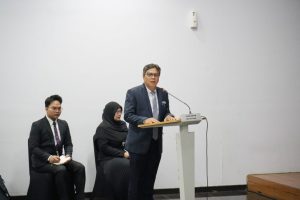
Depok, February 3, 2024. Universitas Indonesia (UI) held an Open Session to Commemorate its 74th Anniversary yesterday at the Convention Hall, UI Campus, Depok. The theme of UI's Anniversary this year is "Continuously Building a Sustainable Indonesia", representing UI as an educational institution that pays great attention to environmental and sustainability issues in accordance with the important points contained in the SDGs. For this reason, UI presented a figure who is considered an "environmental sage", namely Prof. Dr. Jatna Supriatna, Msc., a lecturer and scientist from the Faculty of Mathematics and Natural Sciences (FIMIPA) UI. He delivered a scientific oration speech related to his review from the perspective of conservation and sustainability science. This event opened a series of anniversary commemorations which will culminate on February 21.
Starting his speech, Prof. Jatna gave an overview of three species of Orang Utan in Indonesia, namely Pongo abelli, Pongo tapanuliensis, and Pongo pygmaeus. All three are the main species of Indonesia because they only exist in Indonesia. In addition, Indonesia is also an archipelagic country and is located in a tropical area that has the third largest tropical forest area in the world. Indonesia also has the second longest coastline in the world with a sea area (70%) and land area (30%), in the form of a very large number of islands (>17,000). Prof. Jatna said that this extraordinary biodiversity potential must be used as an asset to provide prosperity and welfare for the Indonesian nation.

The ever-increasing human population and all its activities have created damage to the earth, such as global warming due to greenhouse gas (GHG) emissions, environmental pollution due to hazardous and toxic materials, and loss of biodiversity. In his presentation, Prof. Jatna said that 2023 was the hottest year in the world and the last five years were the hottest temperatures in history since 1850. This year, the earth's temperature has reached an average of 2 compared to pre-industrial ℃ and it is estimated that the earth's temperature will increase even more in the following years.
He explained that an increase of 1 ℃ could melt the ice at the poles and endanger the existence of a number of animals. Then, if the earth experiences an increase of 2 ℃, it can eliminate 40% of the rainforests which ℃ will result in the depletion of animal food reserves. Furthermore, at an increase of 3 ℃, trees ℃ will no longer be able to hold carbon dioxide and big cities will be filled with pollution. "If there is an increase of 5 ℃, I think the earth will no longer be habitable. So, we must be able to brake, so that ℃ does not continue to increase," said Prof. Jatna.
The next earth crisis is the very serious loss of biodiversity, both in quantity and quality of its habitat. The loss of biodiversity is caused by various human activities. Humans are at the center of all sources of environmental crisis problems and threats to the sustainability of biological resources. Therefore, the issue of biological resource conservation is not only a biological technical issue, but also a socio-cultural issue.
Furthermore, Prof. Jatna explained that other earth crises are chemical, plastic, water, and air pollution. Environmental pollution occurs in every corner of the earth, pollutants accumulate in the environment and cause disturbances to habitats that continue to occur until now. Pollutants not only impact the abiotic environment, but also the biotic environment. For that, in addition to simply adapting to various environmental crises, Prof. Jatna said that one of the mitigations of climate change is by developing carbon trading, either in the form of a green and blue economy or through a mix of New and Renewable Energy (EBT) and decarbonization programs and other latest technologies (hydrogen, nuclear and others) and to achieve Net Zero Emission faster than promised.
"We at the university are obliged to scientifically study the various trade-offs in land use, utilization of biodiversity, the impacts of climate change, and policies and management related to forests and the sea. Therefore, we at the university have a duty to empower and unite various development actors, and to connect the knowledge system of communities at the grassroots level with multi-inter-transdisciplinary science in universities in order to improve natural resource governance for the sustainability of inclusive development," said Prof. Jatna.

Meanwhile, in his opening remarks, UI Chancellor Prof. Ari Kuncoro, S.E., M.A., Ph.D., also invited UI academics to preserve the earth, dedicate knowledge, and maintain the dignity of the University of Indonesia. At the age of UI 74, Prof. Ari said, if compared to humans, this age is considered elderly, the productive age has long been left behind, and only enjoy the rest of life.
"However, for educational institutions such as the University of Indonesia, the increasingly mature age reflects how far the journey has been traveled, and also how much meaning our achievements have for Indonesia," said Prof. Ari.
News source : https://sci.ui.ac.id/