|


|

Depok, January 6, 2026 – Microplastics have emerged as a serious threat to mangrove ecosystems. These microscopic plastic particles not only accumulate in sediments but can also enter the bodies of mangrove-associated organisms, potentially penetrating the human food chain. The mangroves of Lampung Bay, which play vital ecological and economic roles—as natural waste filters, coastal erosion barriers, and habitats for diverse biota—have been identified as a concentration point for microplastics originating from both land and marine sources.
In response to these findings, Berta Putri, a doctoral student in the Biology Doctoral Program, Faculty of Mathematics and Natural Sciences, Universitas Indonesia (FMIPA UI), conducted a study to understand the characteristics and distribution of microplastics in the mangrove ecosystem. The results of her research were presented in a dissertation entitled “Characteristics and Distribution of Microplastics in the Mangrove Area of Lampung Bay,” which was defended during an open doctoral promotion session of the FMIPA UI Biology Doctoral Program. The session was chaired by Prof. Dr. Tito Latif Indra, S.Si., M.Si., as head of the examination committee, on Tuesday (January 6) at the Prof. Dr. G.A. Siwabessy Auditorium, FMIPA UI, Depok.
“This study demonstrates the complete pathway of microplastics entering the environment, accumulating in biota, and ultimately affecting microalgal communities, providing a holistic picture of the risks and dynamics of microplastics in the mangroves of Lampung Bay,” Berta stated before the board of examiners.
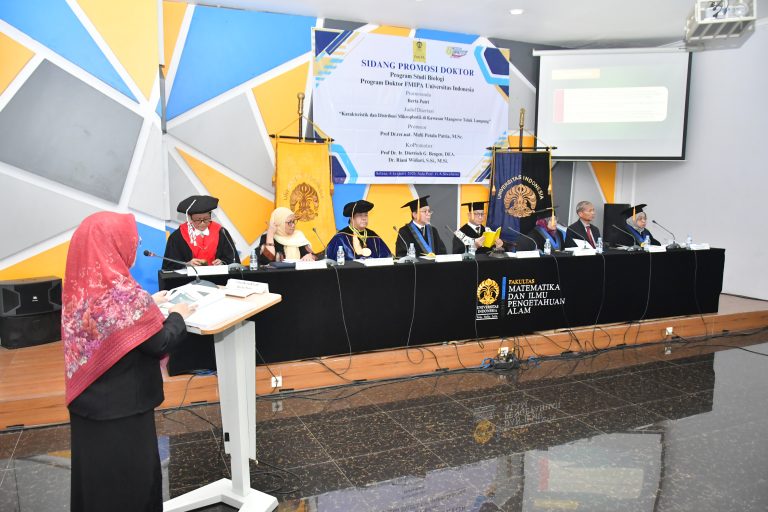
Based on this research, Berta Putri successfully earned her Doctoral degree with a “very satisfactory” distinction, under the supervision of Prof. Dr. rer. nat. Drs. Mufti Petala Patria, M.Sc. as the promoter, and Prof. Dr. Ir. Dietriech Geoffrey Bengen, DEA, along with Dr. Riani Widiarti, S.Si., M.Si., as co-promoters.
The study revealed alarming findings: mangrove sediments contain significant amounts of microplastics, predominantly black and blue fibers, with polyethylene (PE) and polypropylene (PP) as the main polymer types. Large particles (>1000 μm) were frequently detected, indicating that many originate from local activities such as textiles, fishing nets, and single-use plastics that have not yet degraded. This suggests that microplastics can accumulate in mangrove ecosystems, enter the bodies of animals, and potentially penetrate the food chain, posing a threat to both biota and human health.
“We also found that microplastics are not merely a physical pollution issue, but can alter ecosystem interactions, including microalgal communities that form the base of the mangrove food chain. These findings open up opportunities for more targeted and sustainable management strategies,” Berta explained regarding the impacts of microplastics on mangrove ecosystems and their implications for sustainable environmental management.
Microplastics were also detected in the bodies of Telescopium telescopium and Geloina erosa, showing different patterns in accordance with their respective feeding habits. T. telescopium ingests more particles from sediments, while G. erosa ingests microplastics from the water column. This makes both mollusks potential bioindicators of plastic pollution in mangrove ecosystems.
In addition, microplastics serve as a new substrate for epiphytic microalgae, known as the plastisphere. Although the abundance and diversity of microalgae are lower compared to those in sediments and water, diatom communities of the phylum Bacillariophyta remain dominant, particularly the genera Navicula and Nitzschia. These findings indicate that microplastics are not merely a physical problem, but can also alter the structure of microbial communities in coastal ecosystems.
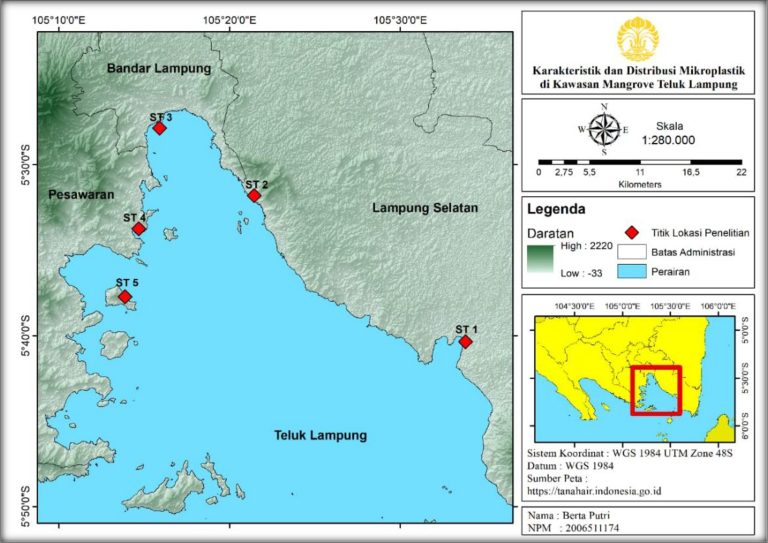
The study was conducted during the east monsoon (September–October 2022) and the west monsoon (May–June 2023), with sediment samples collected to a depth of up to 30 cm and water samples obtained using a plankton net. The results showed the highest microplastic abundance at Station 3 (Kota Karang, 1,260 particles/kg) and the lowest at Station 5 (Kelagian Island, 220 particles/kg). The highest levels in biota were also recorded at Station 3 during the east monsoon, reinforcing the link between human activities and microplastic contamination.
These findings are expected to serve as a scientific basis for sustainable mangrove management, biodiversity conservation, and the protection of coastal community health.