|

The Department of Biology
Faculty of Mathematics and Natural Sciences Universitas Indonesia
Vegetables are foods that are rich in fiber, water, vitamins, minerals, antioxidants, and iron, so vegetables are important foods for the body. Unfortunately, the level of vegetable consumption in Indonesian society is still very low, especially in urban areas. This is due to several factors, one of which is the rise of fast food that is practical and cheap.
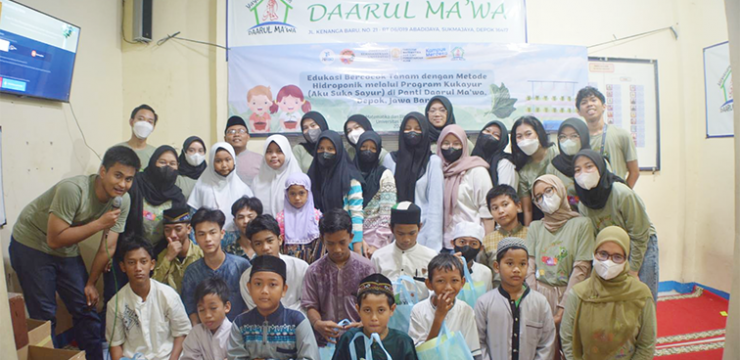
Seeing this fact, the Community Service Team from the Biology and Chemistry Student Association, Faculty of Mathematics and Natural Sciences, University of Indonesia (FMIPA UI) was motivated to implement a farming education program for children through the Kukayur (I Like Vegetables) Program using the hydroponic method, on October 29, 2022, at Panti Daarul Ma'wa, Depok, West Java.
The team involved 22 children at the orphanage to get to know more about vegetables, educate them about the content and benefits of vegetables for the body, and introduce them to how to grow crops using hydroponic methods.
The activity, chaired by Firliani Nabila, led by a lecturer from the Department of Biology, FMIPA UI, Afiatry Putrika, M.Si, was carried out in the form of a presentation of material and a video screening on how to plant vegetables using a hydroponic system, followed by direct practice in planting using a hydroponic system. post to post.
"We started our first activity by delivering the material to the children. Before the presentation of the material, we gave pre-test guna mengukur pengetahuan umum anak-anak tentang sayur dan hidroponik,” ujar Firliani.
The presentation of the material was done by introducing the types of vegetables that can be grown using the hydroponic method and its benefits for the body, and the definition of hydroponics. The material also explained the advantages of the hydroponic method such as more efficient land use, and does not require a lot of costs. The team also educated about the benefits of consuming vegetables for the body.
The presentation of material by students from the Department of Biology and Chemistry, FMIPA UI to the children of the Daarul Ma'wa Orphanage, Depok ended with games interactive to test children's knowledge after the material is presented. The presentation of the material and games This attractive prize received an enthusiastic response from the children.
Educational activities continued with direct practice of how to grow crops using the hydroponic method. post to post. This activity was carried out with the hope that children would get an idea and feel the experience directly, and gain knowledge in farming using the hydroponic method..
Peserta post to post divided into 4 groups with each group consisting of 9-10 people. Activities post to post divided into 3 posts, namely post 1 which explains the educational practice of sowing seeds into rockwool, post 2 which practices making AB Mix fertilizer and post 3 which practices inserting rockwool containing sprouts into netpots, and ends with placing the netpots into a tank containing nutrients. Post to post lasted for 1 hour and all the children looked active in the activity. post to post.
Kukayur activities ended with the distribution of booklet for each child. Not only that, FMIPA UI students also invited participants to conduct a small study to observe the vegetables they had planted for the next 1 month. Participants were asked to measure the height of the plants, the number of leaves, and the color of the leaves observed during the maintenance process. After that, they were also asked to write down what they felt while caring for the plants on booklet that is shared.
Afiatry Putrika, as a supervising lecturer, said that "in Higher Education, our activities are not just studying, but there are 3 things that are done, namely teaching, research, and community service. Through community service, we share the knowledge that has been learned during college. Therefore, through this activity, it is hoped that students will feel the sensation of eating vegetables that are grown by themselves through hydroponic planting and it is hoped that students can complete mini project based on observations of planting carried out".
In addition, the Head of the UI Biology Department Student Association, Edwin Arga, also said, "Through the kukayur activity, it is hoped that students can understand how plants grow even without using soil media, and it is also hoped that students can produce their own vegetables with healthy quality and free from harmful substances so that it can motivate students to like vegetables more."
Positive response from Abdullah Hafidz as the Head of the Daarul Ma'wa Orphanage Foundation who said that the kukayur activity provides knowledge that is rarely found. Through this activity, it is hoped that it can be useful knowledge for the younger siblings regarding hydroponic planting, both for now and for the future.
News source : https://sci.ui.ac.id/