|

|
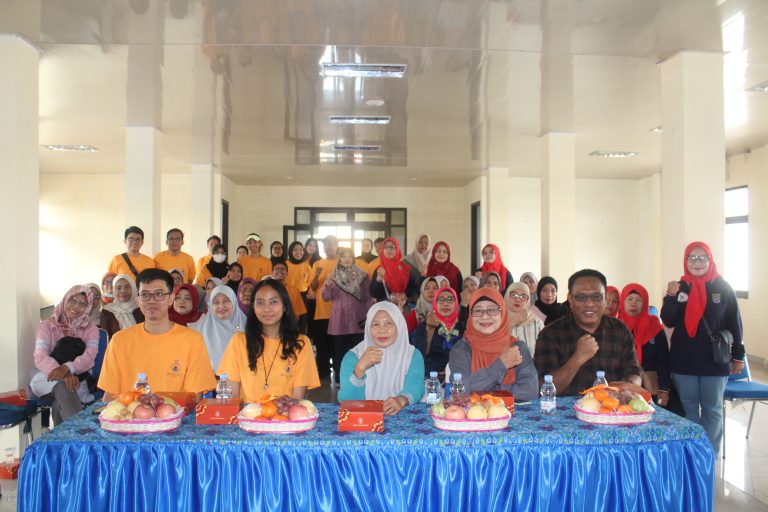
Depok, September 29, 2026 — Improper disposal of used cooking oil can pollute the environment and disrupt drainage systems. This issue prompted the Faculty of Mathematics and Natural Sciences, Universitas Indonesia (FMIPA UI), through its Department of Chemistry, to encourage the community to process used cooking oil into useful household products through its 2026 Community Engagement Program (Pengmas). The program, titled Creative Home: Processing Used Cooking Oil into Aromatherapy and Mosquito-Repellent Candles as an Effort to Empower the Depok Community, introduced practical ways to turn household waste into value-added products..
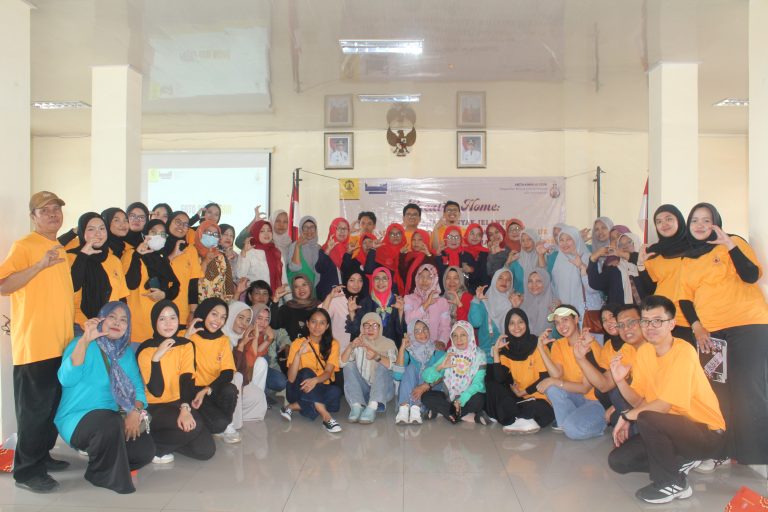
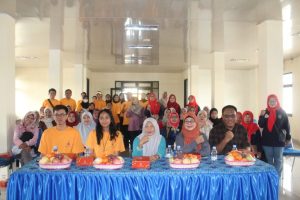
The activity was held at the Depok Village Hall, Pancoran Mas District, Depok, on Saturday, September 26, 2026, and was attended by 35 community members and PKK cadres. Through the program, FMIPA UI applied basic chemistry concepts to help the community manage used cooking oil while introducing opportunities to transform household waste into products with added value.
Head of the 2026 Creative Home Community Engagement Program, Rika Tri Yunarti, S.Si., M.Eng., Ph.D., explained that used cooking oil was selected because the processing method is relatively simple and the resulting products are closely related to household needs.
“We translated our knowledge of chemistry into simple practices so that the community can see that used cooking oil still has value and can be developed into useful household products,” said Rika.
One of the products introduced was aromatherapy candles made from used cooking oil. The team also introduced candles infused with citronella essential oil as an aromatic product that can help reduce the presence of mosquitoes.
According to Rika, producing both types of candles does not require specialized laboratory equipment. Most of the equipment can be found at home, while additional materials such as beeswax, purified used cooking oil, essence or fragrance, and coloring agents are relatively easy to obtain.
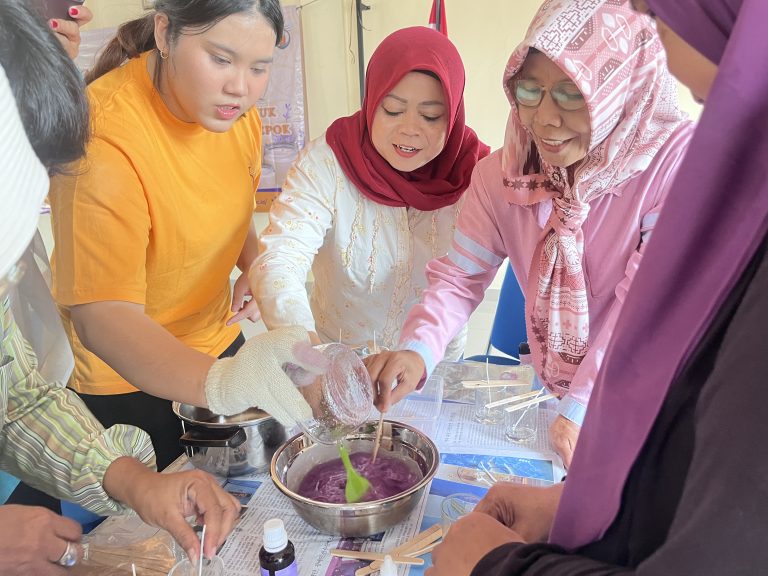
In practice, the used cooking oil first underwent a purification process using bleaching earth and activated charcoal. The process takes approximately 48 hours and was therefore completed by the Pengmas team before the activity. During the training, participants learned about the purification process and practiced formulating the prepared oil into candles.
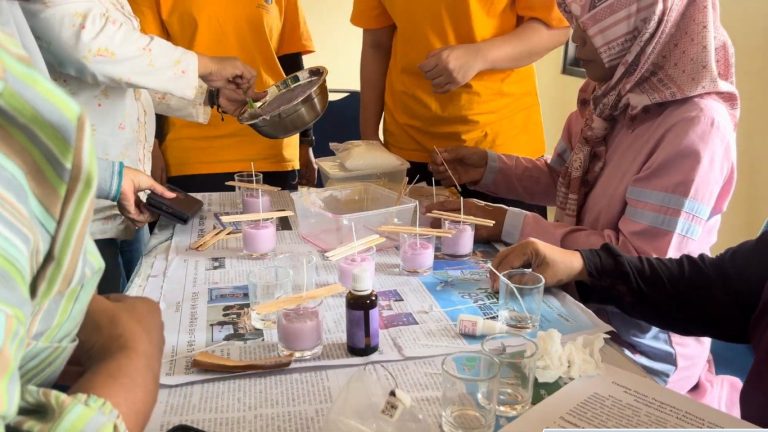
Seven groups each used approximately 460 grams of used cooking oil to produce 14 candles in 60-milliliter shot-glass-sized containers. The practice was designed to provide participants with direct experience in processing used cooking oil on a household scale.
In addition to the hands-on practice, participants learned about the environmental impacts of improper used cooking oil disposal and the concept of a circular economy. The session was delivered by Muhammad Ridwan, S.Si., M.Eng., Ph.D.
“Used cooking oil should not necessarily be viewed as waste that has no further use. With proper management, it can still be reused, helping reduce the potential for pollution while producing products with greater value,” said Ridwan.
According to Ridwan, applying the circular economy concept to used cooking oil management can begin at the household level. The community was not only encouraged to understand the environmental impact of disposing of used cooking oil, but also to recognize opportunities to process it into reusable products.
The application of chemistry in used cooking oil processing involved several stages, including filtration, adsorption, purification, mixing, and product formulation. These concepts were introduced through a practical approach so that participants could understand and apply them independently.
A session on simple techniques for processing and purifying used cooking oil was delivered by Aminah, M.Sc., Ph.D. The techniques provide basic knowledge for community members interested in processing used cooking oil on a household scale.
The program, coordinated by Dewangga Oky Bagus Apriandanu, S.Si., M.Si., Ph.D., also involved members of the Depok Village community, including Muhammad Hadi, Head of RW 012; Sugiwati, Head of Working Group III; and Gita Afrianti, Head of the PKK Working Group (Pokja) of Depok Village, Pancoran Mas District.
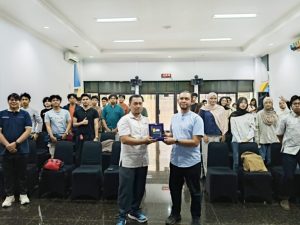
Representing FMIPA UI, the activity was also attended by Bayu Ardiansah, S.Si., M.Si., D.Sc., Head of the Graduate Program at the Department of Chemistry. Meanwhile, the Depok Village Government was represented by Pramudya, S.Sos., Head of Government, Public Order, and Security Affairs.
At this stage, the success of the program was not measured by mass production, but by increasing community understanding and participation. The 35 participants took part in group-based practical sessions and are expected to apply the knowledge they gained, including through PKK groups and community organizations.
Through Creative Home 2026, the Department of Chemistry at FMIPA UI demonstrates that chemistry can be applied beyond the laboratory to address environmental issues closely connected to everyday life. Used cooking oil, previously regarded as waste, was introduced as a material that can still be processed into useful household products and reused in a more responsible manner.