|

|
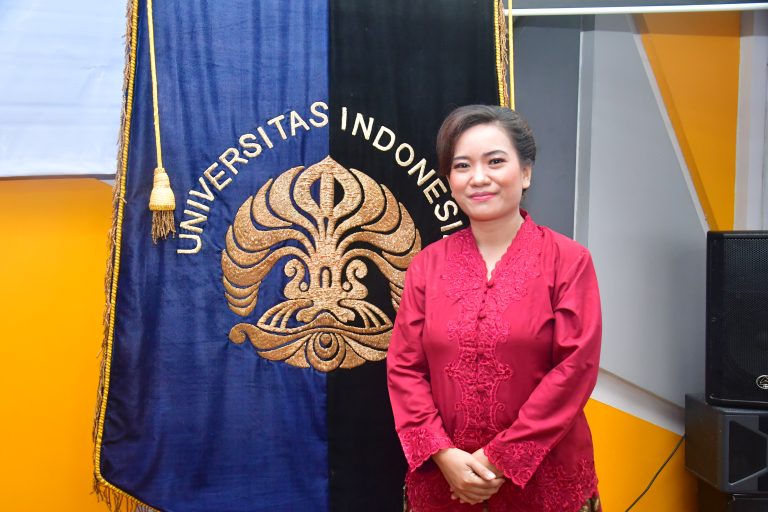
Depok, August 5, 2026 — The development of clean energy has become one of Indonesia’s key challenges amid efforts to reduce dependence on fossil fuels and achieve the net zero emission (NZE) target by 2060. Hydrogen is one of the energy sources being actively developed due to its potential to support the transition toward a low-emission energy system.
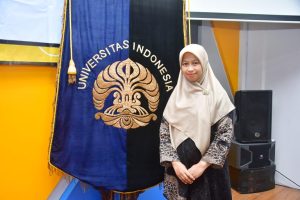
Amid this growing need, Yulian Syahputri, a doctoral candidate in the Chemistry Program at the Faculty of Mathematics and Natural Sciences, Universitas Indonesia (FMIPA UI), developed a material that can support hydrogen gas production by utilizing light energy.
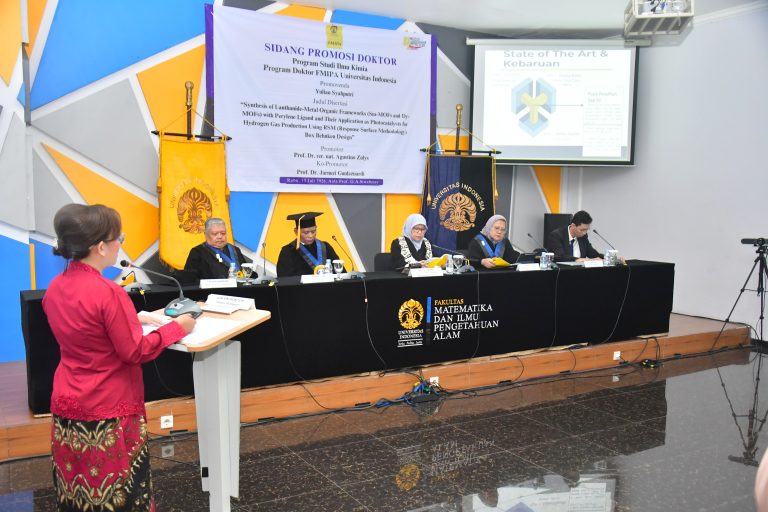
The research was presented during the FMIPA UI Doctoral Promotion held at the Prof. Dr. G.A. Siwabessy Hall, FMIPA UI, Depok, on Wednesday, July 15, 2026. In her dissertation, Yulian developed a material based on samarium and dysprosium, two rare-earth elements, combined with the organic compound perylene.
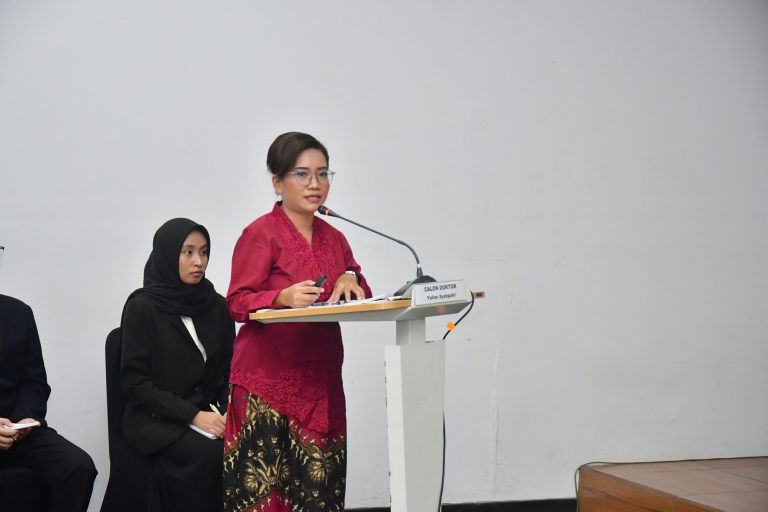
The material functions as a photocatalyst, which is a substance that helps accelerate chemical reactions by utilizing light energy. In this study, the photocatalyst was used to support the production of hydrogen gas.
“This research was initiated by the need to develop materials that can support more effective hydrogen production. We utilized materials based on rare-earth elements and organic compounds that are capable of absorbing light to drive the hydrogen production process,” said Yulian.
The development of hydrogen technology is part of Indonesia’s energy transition agenda. Hydrogen, particularly hydrogen produced using renewable energy sources, has the potential to support emission reductions in sectors that are difficult to fully transition away from fossil fuel use.
In her research, Yulian synthesized two materials, namely Sm-MOFs and Dy-MOFs. Both materials belong to the class of porous materials whose structures can be engineered to possess specific characteristics, including the ability to absorb light and provide spaces for chemical reactions to occur.
The results showed that the samarium-based material achieved a light energy utilization efficiency of 41.4 percent, while the dysprosium-based material reached 26.7 percent.
Through testing and optimization, the samarium-based material was able to produce hydrogen gas at a rate of 0.0084 millimoles per second. Meanwhile, the dysprosium-based material produced hydrogen at a rate of 0.0075 millimoles per second.
To achieve optimal production conditions, Yulian applied a statistical method capable of analyzing the influence of multiple factors simultaneously. This approach helped determine the best combination of conditions while reducing the number of experiments required.
For the samarium-based material, the optimal conditions were achieved using 10 milligrams of photocatalyst, 5 milliliters of methanol, and a reaction time of 60 minutes. Meanwhile, the dysprosium-based material reached its optimal performance using 10 milligrams of photocatalyst, 8.9 milliliters of methanol, and a reaction time of 60 minutes.
“The advantage of this optimization approach is that it allows us to evaluate the effects of multiple factors simultaneously, enabling the optimal conditions to be determined more systematically. Our findings demonstrate that this method is a reliable tool for optimizing hydrogen production using rare-earth-based photocatalysts,” said Yulian.
According to Yulian, these findings represent an early stage in the development of materials for hydrogen production. Nevertheless, the study provides a valuable reference for the development of more efficient photocatalysts and for further research in the field of clean energy.
“Going forward, the materials developed in this study can still be improved, both in terms of efficiency and practical application. We hope this research will serve as one of the foundations for advancing hydrogen production technologies that support Indonesia’s transition to clean energy,” she said.
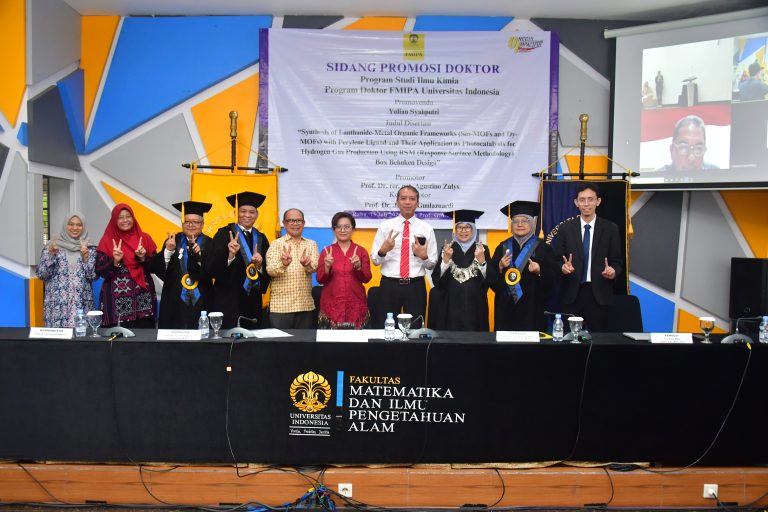
Yulian completed her doctoral studies in 10 semesters with a perfect GPA of 4.00 and graduated with the distinction of Highly Satisfactory. During the doctoral promotion, Prof. Dr. Ivandini Tribidasari Anggraningrum, S.Si., M.Si., Vice Dean for Resources, Venture, and General Administration of FMIPA UI, served as the chair of the examination committee. Her dissertation was supervised by Prof. Dr. rer. nat. Agustino Zulys as the promoter and Prof. Dr. Jarnuzi Gunlazuardi as the co-promoter, both from the Department of Chemistry, FMIPA UI.