|

|

Depok, August 6, 2026 — Ramie (Boehmeria nivea) has long been recognized as a natural source of textile fiber. However, Muhammad Haekal Habibie, a doctoral graduate of the Physics Program at the Faculty of Mathematics and Natural Sciences, Universitas Indonesia (FMIPA UI), has expanded its potential applications. In his research, not only were ramie fibers used as a textile material, but ramie leaves were also utilized to produce ultra-small particles that can impart antibacterial properties to textiles.
The innovation was developed through Haekal’s research titled “Biosynthesis of Zinc Oxide Nanoparticles in a Composite Based on Ramie (Boehmeria nivea L. Gaud) Leaves and Its Application as an Antibacterial Textile.” The study was presented during the FMIPA UI Doctoral Promotion held at the Prof. Dr. G.A. Siwabessy Hall, FMIPA UI, Depok, on Monday, July 13, 2026.
In his research, Haekal utilized hemp leaf extract to help produce particles zinc oxide nanoparticles. These particles were then applied to fabric made from hemp fibers, resulting in a textile capable of inhibiting bacterial growth.
“The key innovation in this research is the comprehensive utilization of the ramie plant. Its fibers are used for textiles, while its leaves are utilized to aid in the production of antibacterial materials,” said Haekal.

According to him, this approach opens up opportunities to utilize hemp as a raw material for functional textiles that does not rely solely on synthetic materials or imports.
Ramie is a plant with the potential to be developed as a local biological resource. Its fibers are strong, moisture-absorbent, and biodegradable, and possess natural antibacterial properties. Meanwhile, ramie leaves contain phytochemical compounds that can facilitate the formation and stabilize nanoparticles zinc oxide.
In this study, Haekal optimized the synthesis process of zinc oxide nanoparticles by adjusting the solution pH and the concentration of the precursor used. The results showed that the optimal conditions were achieved at a solution pH of 8 and a precursor concentration of 1 M.
The resulting nanoparticles are then attached to the hemp fabric through a dyeing process (dip-coating) with the aid of a binder to ensure the nanoparticles adhere more strongly to the fabric surface. This fabric modification process is carried out using a sonication machine to ensure the nanoparticles are evenly dispersed.
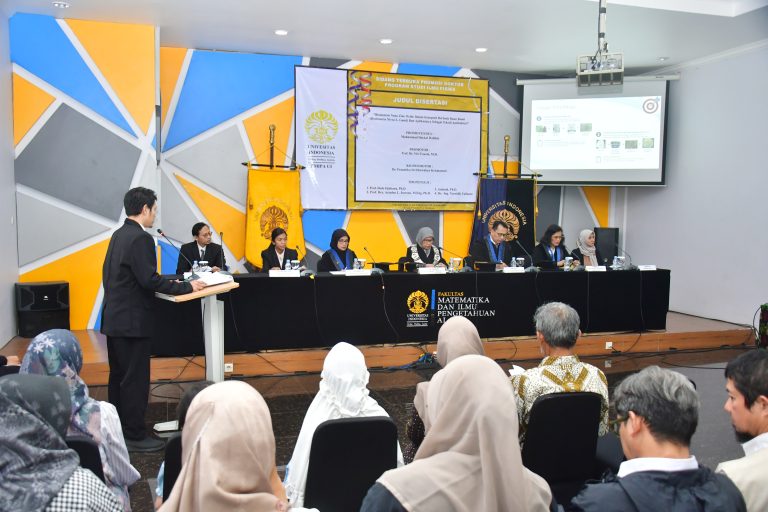
The research results indicate that a binder-to- zinc oxide nanoparticle ratio of 1:20 yielded the best results. Under these conditions, an average inhibition zone of 19.32 millimeters against Staphylococcus aureusbacteria was produced. In general, the zinc oxide-modified hemp fabric produced in this study demonstrated superior antibacterial activity against Gram-positive bacteria compared to Gram-negative bacteria.
“This research demonstrates that local natural materials can be developed into products with enhanced functionality. Ramie need not remain merely a fiber commodity; it can be developed into functional textile materials for healthcare applications,” said Haekal.
The innovation also has the potential to support the strengthening of the textile industry based on local raw materials. To date, the development of functional textiles has largely relied on specific materials and technologies that do not entirely originate from domestic resources.
By utilizing hemp fibers and leaves, this research offers a more integrated approach. Textile raw materials and materials for producing antibacterial materials are obtained from the same plant.
Moving forward, the results of this research have the potential to be developed into various disposable medical textile products, such as bandages, adhesive plasters, masks, and other healthcare products.
“It is hoped that the results of this study can serve as an alternative for developing eco-friendly and cost-effective antibacterial textiles based on local resources. Further development is also required to enable the material's broader application in medical products,” said Haekal.
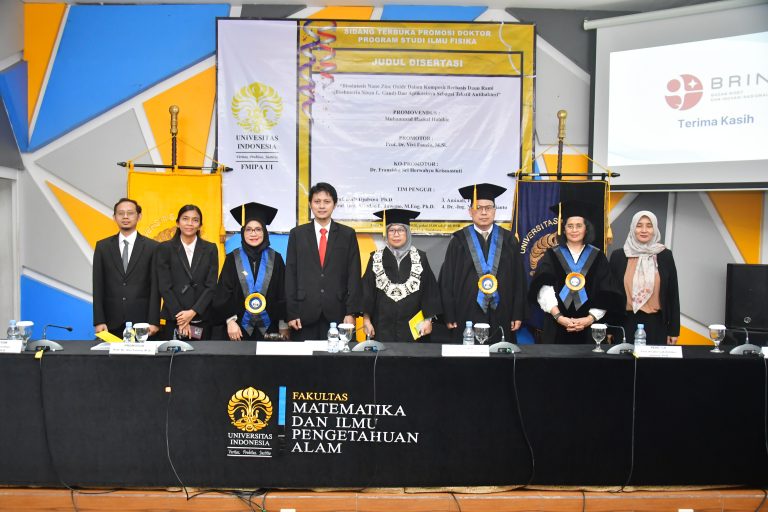
This research was conducted under the guidance of Promoter Prof. Dr. Vivi Fauzia, M.Si., from the Department of Physics, Faculty of Mathematics and Natural Sciences (FMIPA) UI, and Co-Promoter Fransiska Sri Herwahyu Krismastuti, Ph.D., from the Research Center for Molecular Chemistry, National Research and Innovation Agency.
Muhammad Haekal Habibie completed his doctoral studies in eight semesters with a GPA of 3.83 and cum laude honors. The doctoral defense was chaired by Prof. Dr. Ivandini Tribidasari Anggraningrum, S.Si., M.Si., Vice Dean II of the Faculty of Mathematics and Natural Sciences (FMIPA) at the University of Indonesia (UI).