Increasing the competitiveness of agricultural commodities is one of the important agendas for the sustainability of food for the Indonesian people. The quality of nutrition in plants is an important factor that influences the quality of superior agricultural products in Indonesia such as corn, rice, and oil palm. The lack of potassium (K) in oil palm plants, for example, is known to specifically inhibit the productivity of Indonesia's superior commodities which then has the potential to inhibit national economic growth and the livelihoods of small farmers.
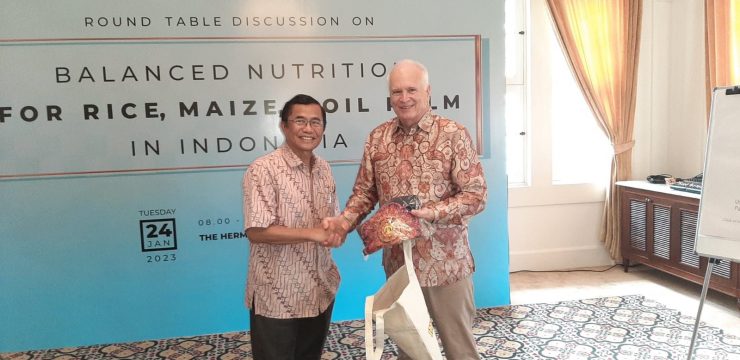
These important findings were outlined in a roundtable discussion. the Round Table Discussion on Balanced Nutrition for Rice, Jagung, and Oil Palm organized by the Research Center for Climate Change, Faculty of Mathematics and Natural Sciences, University of Indonesia (FMIPA UI), and The University of Nebraska-Lincoln-Global Yield Gap Atlas Project (GYGA), in Jakarta on Tuesday, January 24, 2023.
“The Roundtable Discussion highlighted the urgent need for collective initiatives from relevant stakeholders to redirect agricultural research and extension programs while improving fertilizer subsidy programs to ensure adequate and balanced nutrition for smallholder rice, corn, and oil palm crops,” said Prof. Dr. Jatna Supriatna, M.Sc., Professor of Biology, FMIPA UI and senior researcher at RCCC FMIPA UI.
The GYGA team led by Professor Patricio Grassini, together with Indonesian partners from the National Research and Innovation Agency (BRIN), and the Indonesian Palm Oil Research Center (IOPRI), has been conducting a research project to identify the main constraints to yield potential in Indonesia for rice, maize and oil palm on smallholder land. Research on rice and maize began in 2015, while research on oil palm began in early 2018 and will run until 2023.
A research team led by the University of Nebraska together with local partners from BRIN, PPKS, and UI identified that one of the obstacles to harvest results in smallholder farmers' land was triggered by poor and unbalanced nutrition in plants. The team claims this is due to several factors such as farmers' lack of knowledge about the right fertilizer sources, difficulties in obtaining fertilizers, and farmers' lack of purchasing power for the fertilizers.
“The main finding of this research project is that Potassium (K) limits crop yields in most smallholder fields for rice, corn and oil palm crops in Indonesia,” he added.
The Round Table Discussion held in Jakarta offered an initial step to form a joint initiative between the University of Nebraska-GYGA, University of Indonesia, Pupuk Indonesia, BRIN, Coordinating Ministry for Economic Affairs, Indonesian Palm Oil Plantation Fund Management Agency (BPDPKS), Palm Oil Research Center (PPKS), and the Ministry of Agriculture to address the problem of nutritional imbalance for rice, corn, and oil palm in Indonesia.
Key stakeholders attending the discussion agreed to share key findings from the research project conducted from 2015 to 2023 in Indonesia. In the discussion, participants discussed the mechanism for fulfilling the right nutrition for rice, corn, and oil palm fields in Indonesia and sought a solution agenda, such as identifying strategic steps that have a positive impact on some small farmers through increasing plant nutrition from fertilizers.
It was decided in the discussion that as a next step, a consensus document signed by the participants will be issued. The consensus document is addressed to government leaders responsible for adjusting the approach of the fertilizer subsidy program needed by crops, especially oil palm, to fully intensify yields especially during critical times.
News source : https://sci.ui.ac.id/
Post Views: 53