|


|
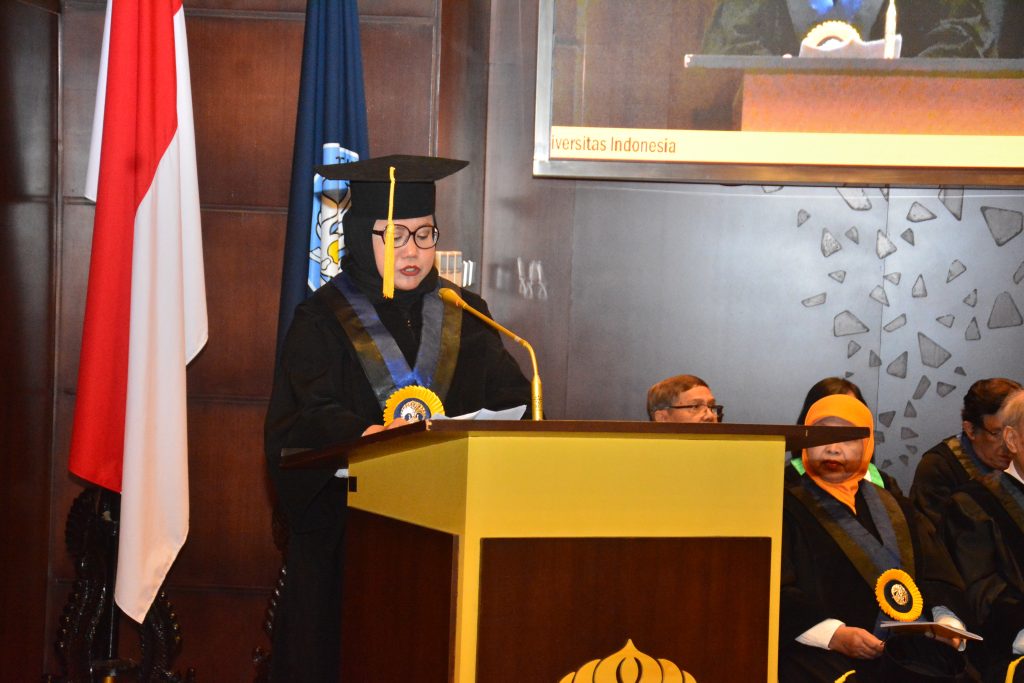
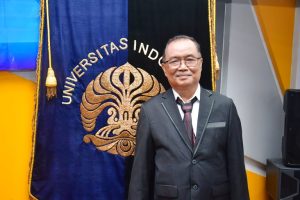
Universitas Indonesia (UI) inaugurated Prof. Yuni Krisyuningsih Krisnandi, S.Si., M.Sc. Ph.D., as a professor in the field of Inorganic Network Materials Science, Faculty of Mathematics and Natural Sciences (FMIPA) at the Convention Hall, UI Depok Campus, this morning. In the procession, she delivered an inaugural speech entitled "Natural Materials as Superior Inorganic Network Material Precursors for Environmental, Energy, and Health Applications".
In her presentation, Prof. Yuni said that Indonesia is a country crossed by the Mediterranean and Pacific circum routes, so it has many mountains containing abundant non-metallic mineral natural materials, as much as more than 770 M tons, and is still relatively cheap (around Rp. 35,000/ton). Non-metallic mineral natural materials that have been widely utilized are alumina silicate materials (derivatives of silicates), a material composed of the smallest units in the form of tetrahedral silicates that are periodically combined to form a complex structure in the form of a network (framework).
Aluminasilicate materials that have been widely utilized by the public are kaolin, bentonite/clay, and natural zeolite. "We are quite familiar with cat litter, and media for reptile pets, whose main components are bentonite and natural zeolite. In addition, stomach ache medicine, whitening clay, and ceramics are examples of the use of clay. Aluminasilicate materials have been utilized in various applications, such as water purification, adsorption, and heterogeneous catalysts to accelerate a chemical reaction," said Prof. Yuni.
He further said that natural aluminasilicate has several weaknesses, including not being able to withstand high temperatures, non-uniform crystal phases, and pore blocking by quartz and other impurities, so pre-treatment is needed before use. Therefore, researchers developed a method for synthesizing aluminasilicate materials using pro-analysis materials that are quite expensive and need to be imported for a relatively long time (2-3 months indent) and are less environmentally friendly. With high abundance in nature, and relatively cheap prices, the use of natural minerals as precursors for the synthesis of aluminasilicate materials can answer these problems.
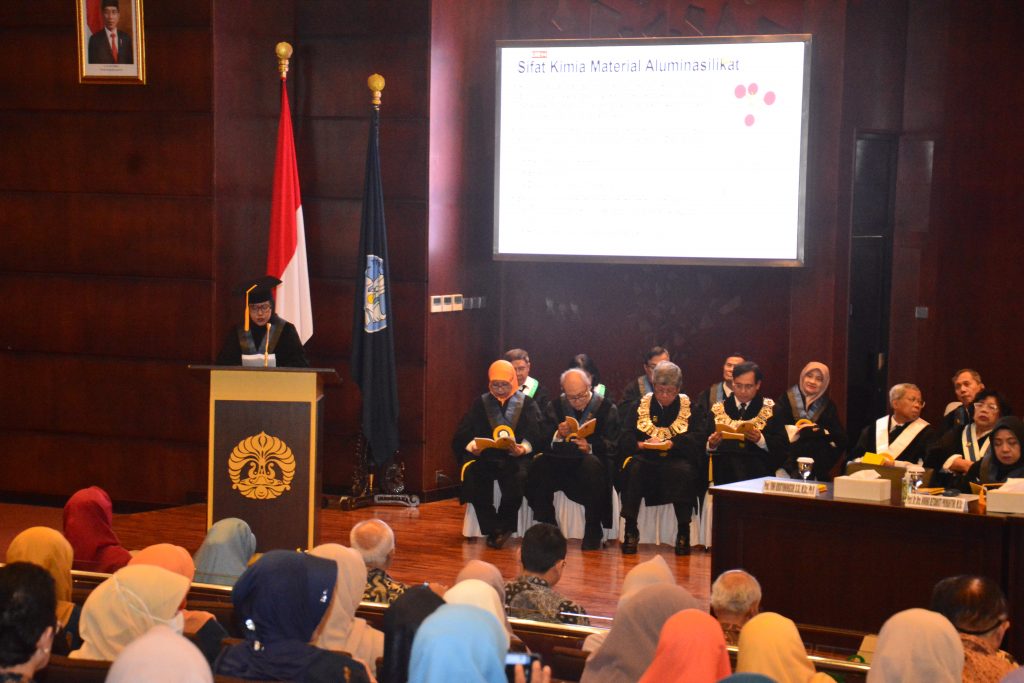
Before being used as a precursor for the synthesis of superior inorganic network materials, natural alumina silicate is given pretreatment, such as activation, purification, fragmentation, and extraction. This stage is the most important part in the preparation of precursors from natural materials, because the geographical location of the origin of the natural material will affect the composition, structure, hardness and impurities in the natural material, so that pretreatment cannot be generalized for all natural materials. After the precursor from the natural material is obtained, the material synthesis can be carried out, as in the synthesis using pro-analysis precursors.
Then, Prof. Yuni explained the utilization of superior inorganic network materials as environmentally friendly catalysts in biomass waste conversion. The compound 2,5-Furandicarboxylic acid (FDCA) is one of 12 priority chemicals where one of its most popular applications is the synthesis of environmentally friendly polyethylene 2,5furandicarboxylate (PEF) which is projected to replace polyethylene terephthalate (PET). "In our study, FDCA was synthesized from 5-hydroxymethylfurfural (5-HMF) by oxidation with the help of
catalyst CuO/ZSM-5 and NiO/ZSM-5 from natural precursors. Delignified cellulose was successfully converted into FDCA in one-pot with a yield of 12.7%.," said Prof. Yuni.
He also explained the utilization of superior inorganic network materials in energy, namely Zeolite NaY based on natural minerals as a catalyst for cracking n-hexadecane. Then, the utilization of superior inorganic network materials in health, namely engineering of local charged RNA extraction kits and utilization of waste as a source of precursors for superior inorganic network materials.
Prof. Yuni said, there are three challenges faced in the development of natural material precursors for the synthesis of superior network materials. First, synthetic Zeolite from the PRC which is much cheaper than the cost of synthesizing superior inorganic network materials from natural materials in Indonesia. Second, the extraction of natural materials or biomass waste if not monitored can disrupt the balance of the ecosystem, and the depletion of important elements in nature over a certain period of time. Third, the scale up of the material synthesis process which requires cooperation with many parties, such as researchers from the faculties of engineering and industry.
"The use of natural materials as precursors for superior inorganic tissue materials must continue to be improved, because it can provide added value, support national independence by adding the percentage of domestic component levels (TKDN), as well as resilience in the fields of environment, energy, and health. Of course, by following the development of science, market needs and sustainable ecosystem balance. Finally, collaboration with universities and research institutions at home and abroad is needed, and UI support to accelerate the achievement of research targets and outputs that have an impact on the wider community," said Prof. Yuni, which was broadcast live on the Universitas Indonesia and UI Teve YouTube channels.
In the inauguration process, the Dean of FMIPA UI (1994-1998 period) Prof. Dr. Endang Asijati; Head of Human Resources Division PT Mowilex Emenda Brahmana; Head of Internal Supervisory Unit of Bogor City Hospital dr. Marthino Robinson, SpPD-KHOM; Regional Business Director of PT IMCD Kristian Hartono, S.Si., MBA; and Director of PT Ecomindo Saranacipta Wahyu Setiaji were present.
Prof. Yuni completed her undergraduate education at the Department of Chemistry, FMIPA UI in 1997. Then, she continued her Masters education at the School of Chemistry, University of New South Wales, Australia and graduated in 2001. In 2005, she successfully obtained a Doctor of Philosophy (Ph.D) degree from the Department of Chemistry, The School of Natural and Computing Sciences, University of Aberdeen, Scotland, UK. Some of her scientific works are entitled Comparative study of microwave – assisted versus conventional heated reactions of biomass conversion into levulinic acid over hierarchical Mn3O4/ZSM – 5 zeolite catalysts (2023); Significance of ZSM – 5 hierarchical structure on catalytic cracking: Intra – vs inter – crystalline mesoporosity (2023); and Metal – organic framework derived ZnO/porous carbon − 13X zeolite composite modified with chitosan and silver nanoparticles as versatile antibacterial agent (2022).
News source : https://sci.ui.ac.id/