Depok, October 24, 2023. As the best university in Indonesia according to UI GreenMetric 2022, Universitas Indonesia (UI) is committed to continuing to maintain the quality of the campus environment, including preserving the biodiversity that lives in the UI lakes. In the Depok campus area, UI has six artificial lakes, namely Kenanga Lake, Aghatis Lake, Mahoni Lake, Puspa Lake, Ulin Lake, and Salam Lake, or often abbreviated as KAMPUS. The six lakes play a role in preserving biodiversity and providing a clean water supply for animals that live in the UI campus area.
Not only functioning as a habitat for various biota, UI's artificial lake also functions as a water catchment that is not only beneficial for UI, but also for the Depok area. The existence of the lake in the UI area supports the environmental carrying capacity of the Depok area which can reduce the impact of flooding during the rainy season and provide water supply during drought. In addition, the UI lake also contributes to regulating microclimate conditions in Depok City in relation to the hydrological cycle.
However, to maintain the stability of the UI lake function, there are several problems that must be faced. Some of them are lake water pollution, lake shallowing due to mud deposits resulting from segmentation originating from the surrounding environment, growth of aquatic weeds, growth of algae due to waste pollution, and the entry of invasive biota that affect the biodiversity habitat.
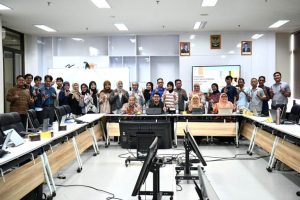
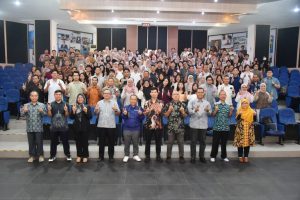
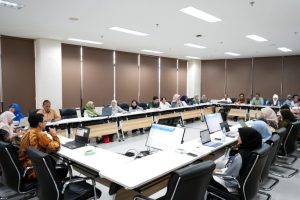
In order to find a solution to the problem, the UI Occupational Health and Safety (K3L) Technical Implementation Unit (UPT) held an activity called “Monitoring Evaluation of Freshwater Ecosystem Conservation in the UI Campus Environment” on Thursday (19/10) in the Auditorium Room, ILRC UI Building. The activity presented two lecturers from the Department of Biology, Faculty of Mathematics and Natural Sciences (FMIPA) UI, namely Drs. Erwin Nurdin, M.Sc., and Drs. Wisnu Wardhana, M.Sc.
According to Erwin, water pollution is one of the factors that affect the health of aquatic ecosystems. Pollution in the waters of UI Lake is caused by human activities outside the UI environment, such as waste disposal from workshops or the release of pesticides from agriculture and other chemicals that enter the lake. This causes damage to the ecosystem in the lake which has an impact on the various biota that live in it.
In fact, according to Wisnu, there are 31 types of fish that live in the UI lake. If the pollution continues, there is concern that there will be a decline in the population of several types of fauna, such as golden snails and shellfish that have now disappeared. "Currently, the janitor fish is the type of fauna that dominates the waters of the UI lake," said Wisnu.
To maintain and preserve freshwater ecosystems, Wisnu said that UI has now made various efforts. First, preventing the release of fish species. Second, limiting the spread and isolating invasive fish by prioritizing the maintenance of native fish. Third, restoring contaminated or damaged waters, and prohibiting the maintenance of invasive fish in the UI environment.
The freshwater ecosystem conservation activity is UI's effort to maintain the sustainability of the ecosystem. This is closely related to the points in the Sustainable Development Goals (SDGs). The focus of conservation activities in point 15 Life on Land has an impact on other SDGs points, namely point 6 Clean Water and Sanitation, point 13 Climate Action, and point 14 Life Below Water. The conservation steps that have been taken are expected to increase and become a priority in the development of UI's environmental policies in the future.
News source : https://sci.ui.ac.id/
Post Views: 186