|

|
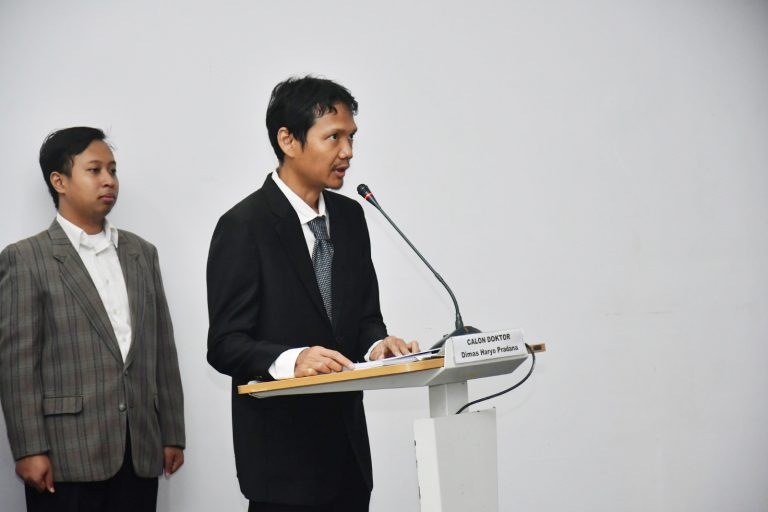
Wild forest birds turn out to play an important role that has long been underestimated in plantation ecosystems, including oil palm. In his dissertation, Dimas Haryo Pradana revealed that understorey bird groups from surrounding forests have the potential to reduce insect pest attacks, particularly by controlling leaf herbivory in smallholder oil palm plantations.
The research was conducted in smallholder plantations on Rupat Island, Riau, and Central Kalimantan, and showed that this potential has not been optimally utilized due to the low abundance of predatory birds in plantation landscapes—mainly caused by habitat degradation and forest fragmentation in the surrounding areas.
The study found that birds such as Centropus sinensis, which are known to prey on bagworms—one of the main pests of oil palm—are difficult to find in landscapes with small and fragmented forest cover.
“These findings deliver a strong message that conservation cannot rely solely on leaving small forest fragments around plantations. A sufficiently large source habitat is needed to support the presence of natural predatory birds,” explained Dimas before the examination committee during his doctoral promotion defense.
He also highlighted that the presence of understory vegetation in plantations has the potential to serve as a microhabitat that supports bird presence, as long as it is managed selectively and not completely cleared.
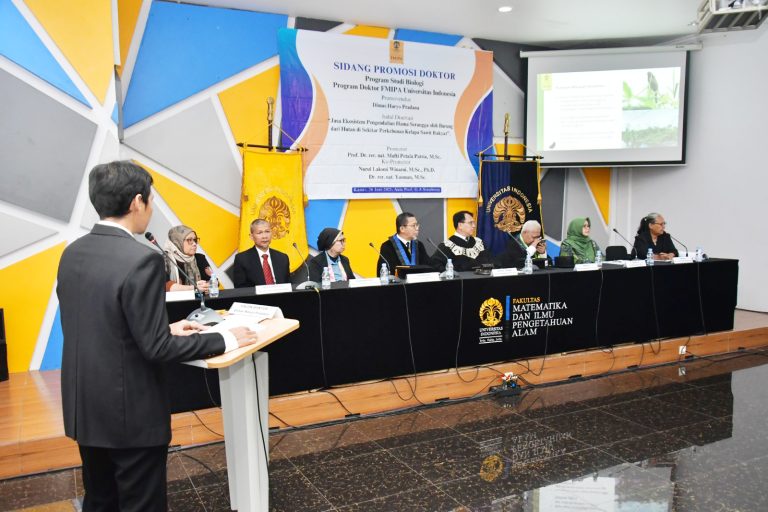
The doctoral promotion took place on Thursday, June 26, 2025, at the Faculty of Mathematics and Natural Sciences, Universitas Indonesia (FMIPA UI). The defense was chaired by the Dean of FMIPA UI, Prof. Dede Djuhana, Ph.D., and accompanied by the advisory committee consisting of Prof. Dr. rer. nat. Mufti Petala Patria, M.Sc. as the Promoter, and Nurul Laksmi Winarni, M.Sc., Ph.D. and Dr. rer. nat. Yasman, M.Sc. as Co-Promoters.
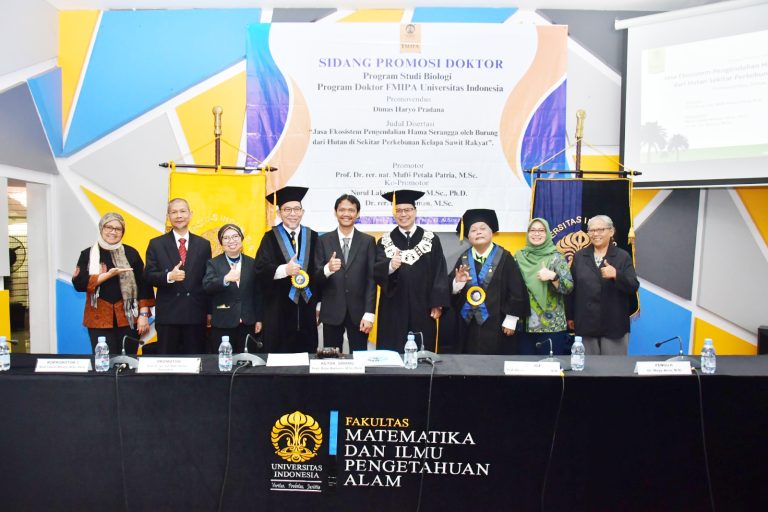
According to Prof. Mufti, this research highlights the importance of a landscape approach in biodiversity conservation, especially in areas that have been dominated by agricultural and plantation land use.
“Dimas’s research is a concrete example of how an ecological approach can be used to support sustainable agriculture. It’s not just about conserving species, but also about how we can utilize the ecosystem services they provide, such as natural pest control,” he stated.
This research, Prof. Mufti continued, makes an important contribution to efforts to improve the productivity and sustainability of smallholder oil palm plantations, while also supporting the implementation of sustainable certification principles such as RSPO and ISPO.
With a science- and field data-based approach, this research is expected to serve as a foundation for plantation landscape governance policies that are more integrated between production and conservation.