|


|
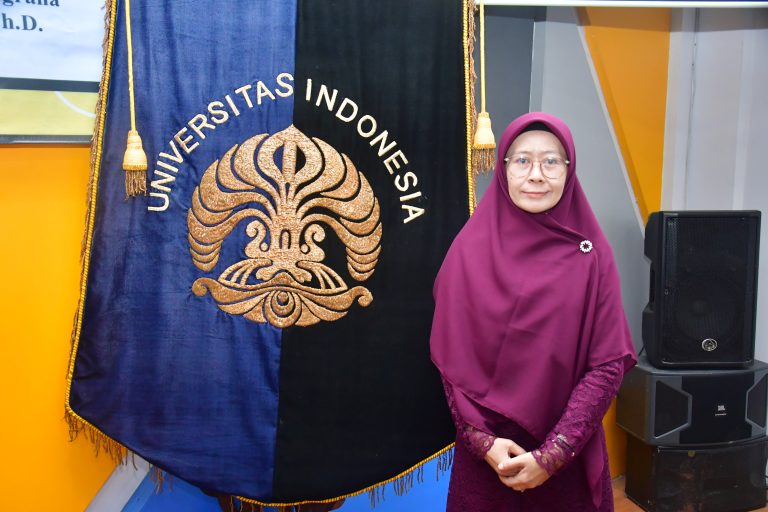
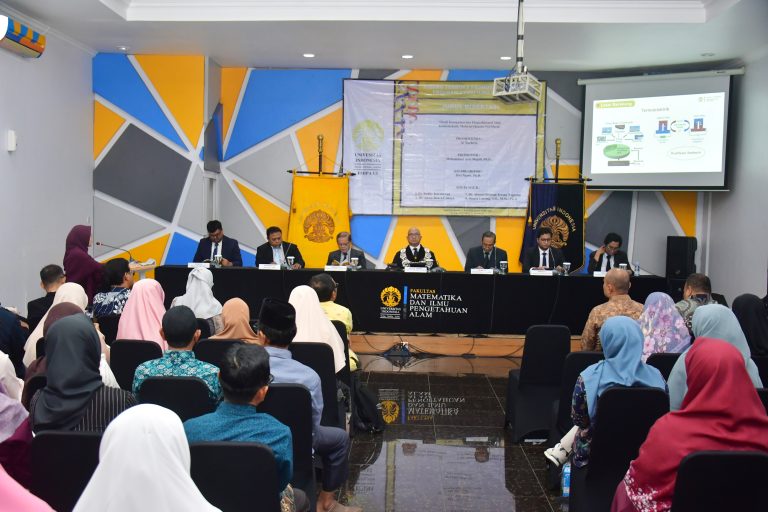
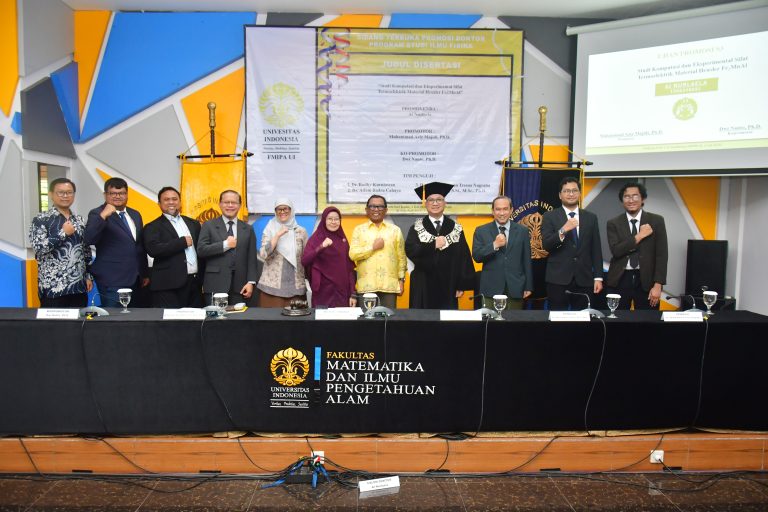
Depok, July 20, 2026 — The need to develop more efficient energy technologies has driven research into materials capable of converting heat into electricity. One such study was conducted by Ai Nurlaela in her dissertation, which she presented during the Doctoral Promotion in Physics at the Faculty of Mathematics and Natural Sciences, Universitas Indonesia (FMIPA UI), on Thursday, July 2, 2026, at the Prof. G.A. Siwabessy Hall, FMIPA UI, Depok.
The doctoral promotion was chaired by Prof. Dr. Tito Latif Indra, M.Si., who also serves as the Dean of the Faculty of Mathematics and Natural Sciences, Universitas Indonesia (FMIPA UI).
In her dissertation, titled Computational and Experimental Study of the Thermoelectric Properties of Fe₂MnAl Heusler Materials, Ai revealed that changes in the magnetic properties and atomic composition can influence the ability of iron-based materials to convert temperature differences into electrical energy.
The development of this technology is highly relevant to the growing need for more efficient energy utilization, particularly by harnessing waste heat generated from various industrial and technological processes. Thermoelectric materials offer a promising approach for converting temperature differences directly into electrical energy.
“The development of heat-to-electricity conversion technology is essential because not all of the energy used in various processes can be utilized directly. Thermoelectric materials offer one approach to harnessing existing temperature differences and converting them into electrical energy,” said Ai.
Thermoelectric materials are materials that generate an electrical voltage when there is a temperature difference across them. Through this principle, waste heat that would otherwise be lost can be converted into usable electrical energy.
In her research, Ai investigated the relationship between magnetic properties, electronic structure, and the ability of iron-based materials to generate electricity from temperature differences using a combination of computational modeling and laboratory experiments.
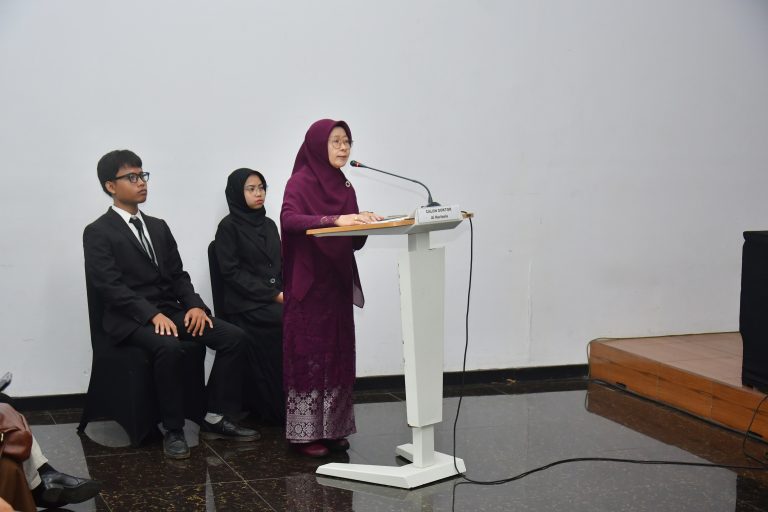
The research focused on two main aspects: first, how temperature-induced changes in magnetic properties affect the material's ability to generate electricity; and second, how fabrication methods and variations in atomic composition influence those thermoelectric properties.
The theoretical study showed that the material exhibits half-metallic characteristics and remains in a ferromagnetic state at low temperatures.
As the temperature increased, the material's magnetic moment gradually decreased until it approached zero. This behavior indicates a transition from the ferromagnetic phase to the paramagnetic phase at a temperature of approximately 150 kelvin (K).
To understand how these changes affect the material's ability to generate electrical voltage from temperature differences, Ai employed Density Functional Theory (DFT) calculations in combination with Boltzmann transport theory.
The calculations were performed by varying the smearing (degauss) parameter in the simulations. The resulting values were then calibrated against experimental data on the temperature-dependent changes in the material's magnetization.
The theoretical analysis showed that an approach incorporating temperature-induced changes in the material's magnetic properties produced Seebeck coefficient trends that were in closer agreement with the experimental results than the conventional approach, which relied on a single degauss value throughout the calculations.
The Seebeck coefficient is one of the key parameters used to measure a material's ability to generate an electrical voltage in response to a temperature difference.
“Temperature-induced changes in magnetic properties need to be taken into account when predicting a material's behavior more realistically. Our approach demonstrates that magnetic phase transitions can influence the electrical characteristics generated by temperature differences,” said Ai.
In addition to the theoretical study, the research compared two material fabrication methods: arc melting and spark plasma sintering (SPS). The materials were tested over a temperature range of approximately 300–800 kelvin (K).
Material characterization showed that the samples fabricated using the spark plasma sintering (SPS) method had a composition that more closely matched the ideal stoichiometric composition. In contrast, the samples produced by the arc melting method contained a higher iron content and lower concentrations of manganese and aluminum.
Composition analysis revealed that the arc-melted material contained 64.19 wt% iron (Fe), 24.75 wt% manganese (Mn), and 11.06 wt% aluminum (Al). In comparison, the material produced by the spark plasma sintering (SPS) method contained 56.43 wt% iron (Fe), 27.59 wt% manganese (Mn), and 13.45 wt% aluminum (Al).
The composition of the SPS-fabricated material was closer to the ideal stoichiometric composition than that of the arc-melted material. However, the arc-melted material exhibited a higher Seebeck coefficient at certain temperatures.
At a temperature of approximately 300 kelvin (K), both materials exhibited positive Seebeck coefficients. As the temperature increased, the Seebeck coefficient gradually decreased. The SPS-fabricated material became negative at higher temperatures, whereas the arc-melted material maintained a positive Seebeck coefficient up to approximately 425 K before transitioning to negative values.
To explain these differences, Ai modeled various possible changes in the material's composition and atomic defects using Density Functional Theory (DFT) calculations in combination with BoltzTraP2 simulations.
The modeling results indicated that an excess of iron (Fe) atoms accompanied by a deficiency of manganese (Mn) or aluminum (Al) atoms can increase the Seebeck coefficient compared with a material of ideal composition. The formation of manganese and aluminum vacancies was also found to enhance the Seebeck coefficient, particularly at elevated temperatures.
“These findings demonstrate that materials with compositions that are not perfectly ideal do not necessarily exhibit lower performance. In this study, an excess of iron and the presence of specific atomic vacancies actually enhanced the material's ability to generate electrical voltage from temperature differences,” said Ai.
These theoretical findings are consistent with the experimental observations of the material fabricated using the arc melting method. The material contained a higher concentration of iron (Fe) and lower concentrations of manganese (Mn) and aluminum (Al) than the ideal stoichiometric composition.
According to Ai, even small changes in a material's composition and atomic arrangement can alter its electronic structure. These changes, in turn, affect the distribution of charge carriers, which plays a crucial role in the material's ability to generate electrical voltage from temperature differences.
These findings demonstrate that a material's ability to convert heat into electricity is not determined solely by the elements that compose it. The fabrication method, as well as subtle changes in its composition and atomic arrangement, can also significantly influence its performance.
Overall, this study demonstrates that changes in magnetic properties and material composition are two critical factors that must be considered in the development of materials for heat-to-electricity conversion technologies.
Controlling the material's composition and the types of defects within its atomic structure may serve as an effective strategy for optimizing the performance of iron-based materials in thermoelectric applications.
Ai Nurlaela completed her doctoral research under the supervision of Promoter Muhammad Aziz Majidi, Ph.D., from the Department of Physics, Faculty of Mathematics and Natural Sciences, Universitas Indonesia (FMIPA UI), and Co-Promoter Dwi Nanto, Ph.D., from the Physics Education Study Program, Faculty of Educational Sciences, UIN Syarif Hidayatullah Jakarta.
This research contributes to the advancement of materials physics, particularly by enhancing the understanding of the relationships among magnetic properties, electronic structure, atomic composition, and a material's ability to convert temperature differences into electrical energy.