|

|

Depok, July 21, 2026 — Cancer remains one of the major health challenges requiring continued attention, including in Indonesia. Amid the growing need for more effective and safer treatments, the exploration of Indonesia's rich biodiversity as a source of therapeutic compounds continues to advance. One such effort is reflected in a doctoral research project at the Faculty of Mathematics and Natural Sciences (FMIPA), Universitas Indonesia (UI), which has led to the discovery of a new compound from an endemic Sumatran plant with the potential to combat breast cancer cells.
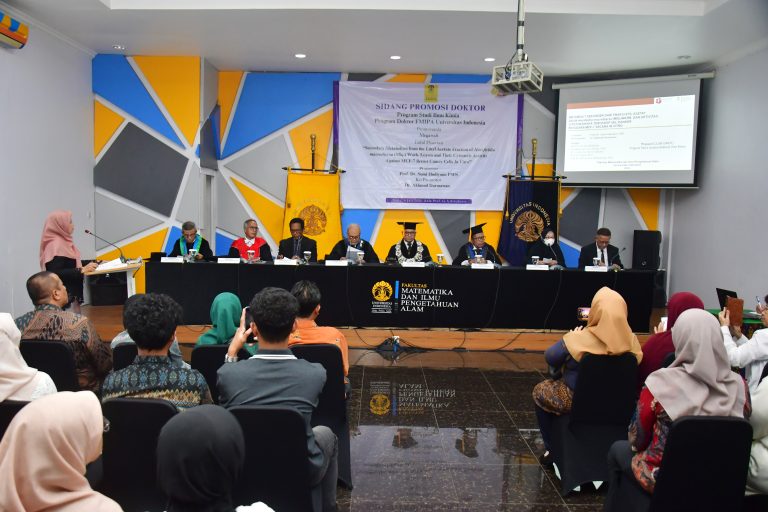
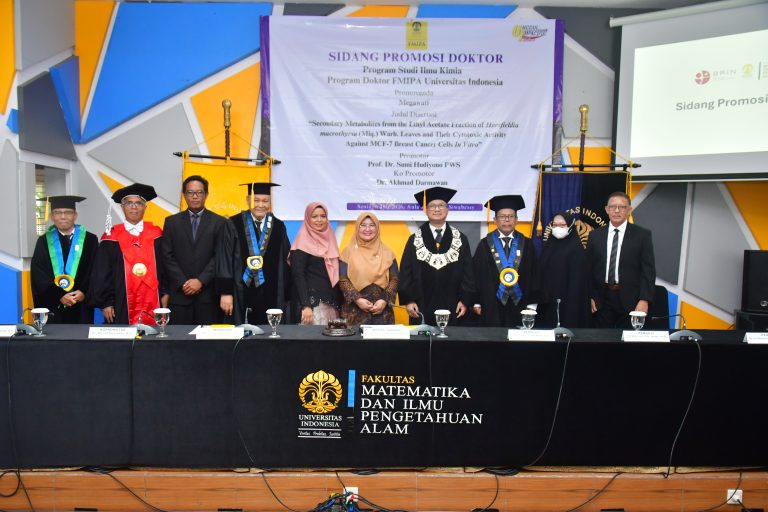
The findings were presented by Megawati during her Doctoral Promotion in Chemistry at the Faculty of Mathematics and Natural Sciences, Universitas Indonesia (FMIPA UI), held at the Prof. G.A. Siwabessy Hall, FMIPA UI, Depok, on Monday, July 6, 2026. She defended her dissertation entitled "Secondary Metabolites from the Ethyl Acetate Fraction of Leaves Horsfieldia macrothyrsa (Miq.) Warb. and Their In Vitro Cytotoxic Activity Against MCF-7 Breast Cancer Cells."
Megawati completed her doctoral studies with a GPA of 3.96 and graduated with the distinction of Summa Cum Laude. The doctoral promotion was chaired by the Dean of FMIPA UI, Prof. Dr. Tito Latif Indra, M.Si. Her research was supervised by Promoter Prof. Dr. Sumi Hudiyono PWS from the Department of Chemistry, FMIPA UI, and Co-Promoter Dr. Akhmad Darmawan, M.Si., from the Research Center for Pharmaceutical and Traditional Medicine Raw Materials, National Research and Innovation Agency (BRIN).
“This research was motivated by the ongoing challenges in cancer treatment. Breast cancer remains one of the most common types of cancer affecting women. At the same time, existing treatment options continue to face challenges, including adverse side effects and declining drug effectiveness in some patients,” Megawati said before the examination committee.
These challenges have driven the search for new drug candidates, including those derived from natural products. Indonesia possesses exceptionally rich biodiversity, yet many of its plant species remain underexplored and their potential applications in healthcare have yet to be fully developed.
The plant investigated in this study was Horsfieldia macrothyrsa (Miq.) Warb., an endemic plant native to the island of Sumatra belonging to the nutmeg family (Myristicaceae). Prior to this study, information regarding the plant's chemical constituents and biological activities was still very limited.
“Indonesia is home to an extraordinary diversity of plant species, yet many of them have not been thoroughly studied. This research demonstrates that endemic plants such as H. macrothyrsa still hold significant potential to yield new discoveries that can be further developed for healthcare applications,” she added.
The study was conducted using the leaves of H. macrothyrsa collected from the forests of Sumatra and maintained as part of the living collection at the Cibinong Botanical Gardens, Bogor, West Java. Through a series of isolation and analytical procedures, Megawati successfully isolated six compounds from the plant's leaves.
The six compounds were subsequently analyzed to determine their chemical structures and properties. A comprehensive review of the scientific literature revealed that one of the isolated compounds had never been reported before, allowing it to be classified as a newly discovered compound.
“The discovery of a new compound is one of the key outcomes of this research. This finding expands our knowledge of the natural chemical constituents of H. macrothyrsa and opens up opportunities for further investigation into its potential applications and benefits,” she added.
The six compounds were subsequently evaluated for their ability to inhibit the growth of breast cancer cells. The results showed that four of the compounds exhibited inhibitory activity against breast cancer cell growth, although with varying levels of effectiveness.
At the same time, none of the tested compounds exhibited toxic effects on normal cells (Sel vero) used as a comparison. This finding is an early indication that these compounds have the potential to have a more selective effect on cancer cells.
"The finding that these compounds can inhibit the growth of breast cancer cells, but do not show any toxic effects on normal cells, is an important result that requires further research," said Megawati.
The research also examined how these compounds might interact with specific parts of cancer cells. The results showed that several compounds possessed characteristics that support the possibility of anticancer activity.
However, Megawati emphasized that the findings are still preliminary. Further research is needed to understand the compound's mechanism of action more deeply and to test its safety and effectiveness through subsequent research phases.
“This research is an initial step to identify the potential H. macrothyrsa as a natural source of ingredients for the development of anticancer drug candidates, further research is needed before these findings can be further developed," he added.
Through this research, the Faculty of Mathematics and Natural Sciences (FMIPA) of the University of Indonesia (UI) is enriching studies on the use of Indonesia's biological resources to support the development of science and innovation in the health sector. In addition to discovering new compounds, this research also provides preliminary information on the potential of endemic Sumatran plants as a source of natural ingredients for the development of breast cancer drug candidates.
These findings also demonstrate the importance of ongoing research to transform Indonesia's biological wealth into knowledge and innovation that can support national health development efforts.