|

|

Depok, August 3, 2026 — Efforts to develop new approaches for understanding and detecting colorectal cancer continue as the disease remains a major health burden in Indonesia. Researchers from the Faculty of Mathematics and Natural Sciences, Universitas Indonesia (FMIPA UI), have introduced an innovative approach by investigating proteins that regulate the intracellular transport of various cellular components as potential biological markers (biomarkers) for colorectal cancer.
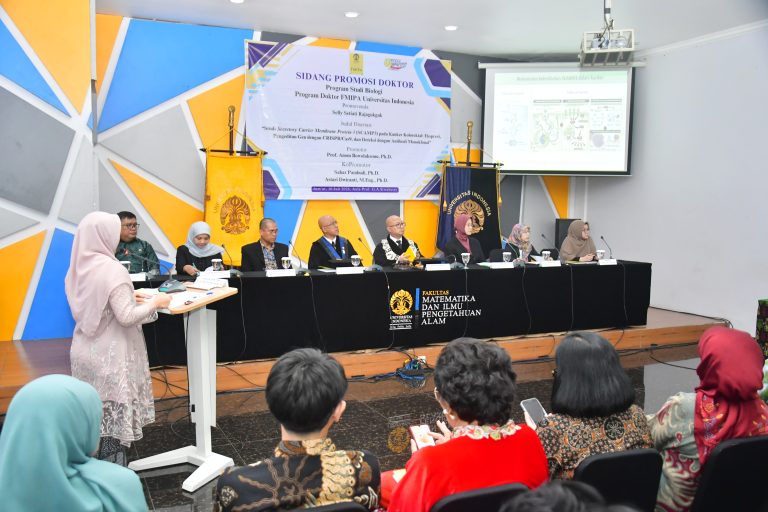
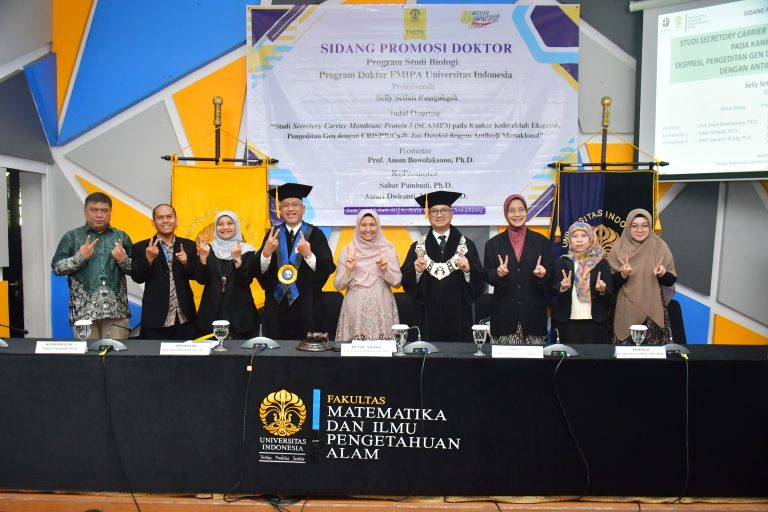
The potential of this approach was demonstrated through the doctoral research of Selly Setiati Rajagukguk, which she presented during her doctoral defense in the Biology Doctoral Program at FMIPA UI on Friday, July 10, 2026, at the Prof. Dr. G.A. Siwabessy Hall, FMIPA UI, Depok. The study was conducted in collaboration between FMIPA UI and Indonesia's National Research and Innovation Agency (BRIN), with the majority of the research activities carried out at BRIN's research facilities. Selly completed her doctoral studies in six semesters, earning a GPA of 3.90 and graduating cum laude.
In her dissertation, entitled Study of Secretory Carrier Membrane Protein 3 (SCAMP3) in Colorectal Cancer: Expression, Gene Editing Using CRISPR/Cas9, and Detection with Monoclonal Antibodies, Selly investigated the presence, function, and detection of SCAMP3 in colorectal cancer cells.
The protein investigated in this study plays a key role in regulating the transport, trafficking, and recycling of various cellular components. Previous studies have shown that elevated levels of this protein are associated with the progression of several types of cancer.
“This protein has previously been associated with several types of cancer, but experimental studies on its role in colorectal cancer remain limited. Therefore, this research aims to investigate it more comprehensively, from its production and expression in cancer cells to the evaluation of its biological function,” said Selly.

The study is particularly relevant given the high incidence of colorectal cancer. According to the GLOBOCAN 2022 data cited in the research, Indonesia recorded more than 35,000 new cases of colorectal cancer and over 19,000 deaths from the disease.
These figures underscore the importance of developing new approaches to improve the detection and understanding of colorectal cancer. Existing screening methods, such as endoscopy and stool-based tests, have certain limitations, highlighting the need to identify alternative biomarkers.
Selly then investigated whether this cell regulatory protein also plays a role in colorectal cancer. The analysis showed that the protein was expressed at higher levels in colorectal cancer cells than in normal cells.
The study went beyond measuring protein expression. Selly also investigated its role in the survival of colorectal cancer cells using CRISPR/Cas9 gene-editing technology. This approach was used to disable the gene responsible for producing the protein, allowing the resulting changes in the cancer cells to be observed.
When the production of the protein was suppressed, the viability of the colorectal cancer cells decreased. One of the gene-editing constructs, sgRNA90, produced the strongest effect. Following treatment, the cancer cells gradually underwent morphological changes before ultimately dying.
“When the expression of this protein was suppressed, we observed changes in the condition and viability of the cancer cells. These findings suggest that the protein has the potential not only to serve as a biomarker for colorectal cancer but also to be further explored as a therapeutic target,” said Selly.
To support the detection process, the study also developed an anti-SCAMP3 monoclonal antibody. This antibody was designed to specifically recognize the SCAMP3 protein.
The D8 clone monoclonal antibody, developed using hybridoma technology, successfully recognized the SCAMP3 protein in a series of experiments. Its specificity was confirmed through ELISA, Western blot, and immunofluorescence assays.
Simply put, a monoclonal antibody works like a highly specific detection tool designed to recognize a particular target. In this study, that target was the SCAMP3 protein found in colorectal cancer cells.
In addition to developing the monoclonal antibody, Selly successfully produced the SCAMP3 protein using two expression systems: the bacterium Escherichia coli and the silkworm Bombyx mori. Using these two systems enabled the researchers to compare different protein production approaches, providing a foundation for further studies on this membrane protein.
The doctoral defense was chaired by the Dean of FMIPA UI, Prof. Dr. Tito Latif Indra, M.Si. The research was supervised by Promoter Prof. Anom Bowolaksono, Ph.D. (FMIPA UI), with Co-Promoters Sabar Pambudi, Ph.D. (National Research and Innovation Agency/BRIN) and Astari Dwiranti, M.Eng., Ph.D. (FMIPA UI).
The findings on SCAMP3 still require further investigation before they can be applied in clinical practice. Future studies are needed to better understand the protein's biological role, evaluate the precision of the gene-editing approach, and assess the performance of the anti-SCAMP3 antibody in a broader range of colorectal cancer models.
Nevertheless, the study provides a foundation for advancing biomarker research for cancer using molecular biology technologies in Indonesia. By integrating protein production, gene editing, and monoclonal antibody development, the research also demonstrates the potential of a multidisciplinary approach to developing new strategies for the detection and treatment of colorectal cancer.
The study highlights the importance of collaboration between universities and national research institutions in driving innovation in molecular biology. The partnership between FMIPA UI and BRIN enabled researchers to leverage advanced research facilities, supporting the development of biomarkers and new strategies for the detection of colorectal cancer in Indonesia.