|



|

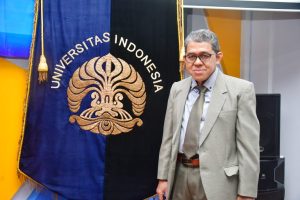
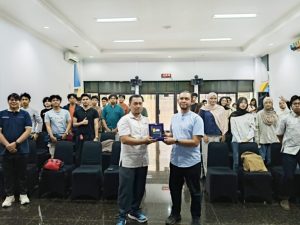
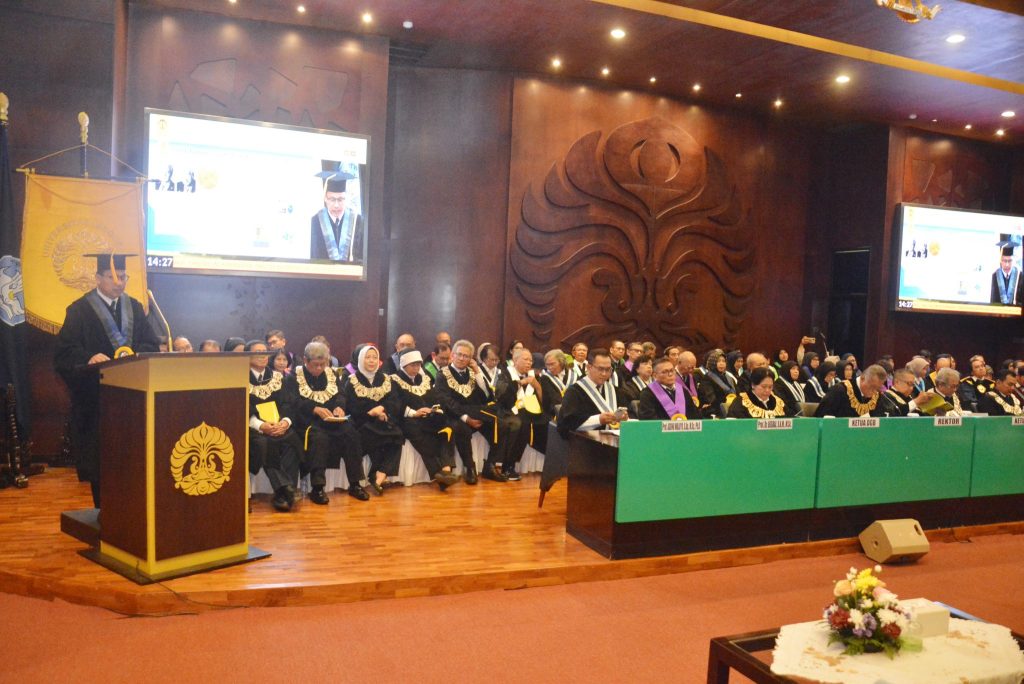
Prof. Dede Djuhana, M.Sc., Ph.D. who is the Dean of the Faculty of Mathematics and Natural Sciences (FMIPA) of the University of Indonesia (UI) was inaugurated as a Permanent Professor in the Field of Material Science, FMIPA UI, on Wednesday (11/15), at the UI Campus Assembly Hall, Depok. The inauguration procession which was broadcast live through the UI Youtube channel and UI Teve was led directly by the UI Chancellor, Prof. Ari Kuncoro, S.E., M.A., Ph.D.
In a scientific oration entitled "Application of Micromagnetic Simulation in Research on the Structure and Dynamics of Ferromagnetic Material Domains", Prof. Dede said that data storage devices have become an important need for documentation purposes in the current digital era. Hard-disk drive (HDD) type data storage devices are a type of data storage that is popular among the public because they have affordable prices, large capacity, and are quite durable for a certain period of time. In general, HDD type data storage is still popular even though currently there are many uses of solid-state drives (SSD) as data storage. hard-disk drive (HDD) is a type of data storage that is popular in society because it has an affordable price, large capacity, and is quite durable in a certain period of time. In general, HDD type data storage is still popular even though currently there are many uses of the HDD type. solid-state drive (SSD) as data storage.
Prof. Dede sees challenges in the process of recording magnetic media or magnetic recording in the future. The challenges are in the form of writability, signal-to-noise, and thermal stability. In addition, magnetic media recording using conventional technology has a capacity limit, which is an average of 1 Tb/in2.
To increase the magnetic recording capacity, new innovations can be created by using patterned-media, assisted-thermal or solid state. High capacity density of magnetic media recording can be achieved by reducing the size grain. However, this reduction in size will have an impact on the magnetization. grain become unstable or known as super paramagnetic limit (SPM).
Magnetization grain so easily changed from one state to another due to the influence of temperature. Magnetization time transition grain in the SPM area it is known as Néel relaxation time. This means that if you are able to control the magnetization conditions against thermal fluctuations in grain, magnetization stability in the SPM region can be obtained.
“In 2008, a research group from IBM Almaden, USA led by Stuart Parkin published a magnetic recording device called Racetrack memory (RM). The RM device is in the form of solid-state memory, non-volatile(RM). The RM device is in the form of Walker breakdown and Joule heating "It is a challenge to develop devices so that the domain structure is stable," said Prof. Dede.
According to him, one of the tool important in magnetic domain structure research is simulation micromagnetic. Micromagnetic is a field of magnetism that studies the dynamic structure of magnetic domains using a mathematical approach. Continuum to explain the nature and dynamics of magnetic domain structures. In the last two decades, simulation results micromagnetic greatly assist researchers in the analysis of ferromagnetic domain structures. Therefore, in his research, Prof. Dede conducted simulations micromagnetic by using several models, namely the ball model, the model nanowire lurus, dan nanowire notch, to observe the structure and dynamics of magnetic domains of ferromagnetic materials. Simulations under conditions ground state provides information on domain structure transitions from single-domain (SD) menjadi multi-domain (MD) of the system energy profile, such as demagnetization energy and exchange.
Prof. Dede's research on simulation applications micromagnetic This is one of the many studies he has conducted. Some of them are: Investigation of Harmonic and in Harmonic Domain Wall Oscillation by Sinusoidal Magnetic Field in the Notched Permalloy Nanowire using Micromagnetic Approach (2023); Single-step Laser Ablation Synthesis of ZnO–Ag Nanocomposites for Broad-Spectrum Dye Photodegradation and Bacterial Photoinactivation (2023); dan Femtosecond Laser-Induced Photochemical Synthesis of Gold Nanoparticles in Nitrate Solution (2022).
Prof. Dede Djuhana, M.Sc., Ph.D. completed his undergraduate (1999) and postgraduate (2003) education at the Department of Physics, FMIPA UI. He obtained his Ph.D. from the Department of Physics, College of Science, Chungbuk National University, Cheongju, South Korea (2009). Prior to serving as Dean of FMIPA UI, he served as Director of Research and Development at UI in 2020–2022.
The inauguration procession of Prof. Dede as a professor was also attended by the Dean of the Faculty of Mathematics and Natural Sciences, Jakarta State University, Prof. Dr. Muktiningsih, M.Sc.; Dean of the Faculty of Mathematics and Natural Sciences, ITB/HFI, Prof. Wahyu Srigutomo; Head of the Magnetic Materials and Nanoparticles Research Group, Center for Advanced Materials Research, BRIN, Prof. Dr. Wisnu Ari Adi; Chairman of the Indonesian Magnetic Society, Prof. Agustinus Agung Nugroho Sulistyo Hutomo; Head of STMKG, Dr. Suko Prayitno Adi; and President Commissioner of PT Luas Birus Utama, Dr. Ir. Harris Susanto, S.Sc., M.Hum.
News source : https://sci.ui.ac.id/