|


|

Depok, July 29, 2026 — Microplastic pollution poses not only a serious threat to marine ecosystems but also a potential risk to the sustainability of high-value marine commodities. Doctoral research conducted at the Faculty of Mathematics and Natural Sciences, Universitas Indonesia (FMIPA UI) found a link between declining environmental quality, microplastic contamination, and reduced productivity in pearl oyster farming in Lombok, West Nusa Tenggara.
The research was conducted by Nestiyanto Hadi through his dissertation titled “Sustainability of Pinctada maxima pearl oysters pearl oysters. Pearl Producing Oyster Farming in Lombok: Environmental Quality, Microplastic Contamination, and Gonadal Histology.”
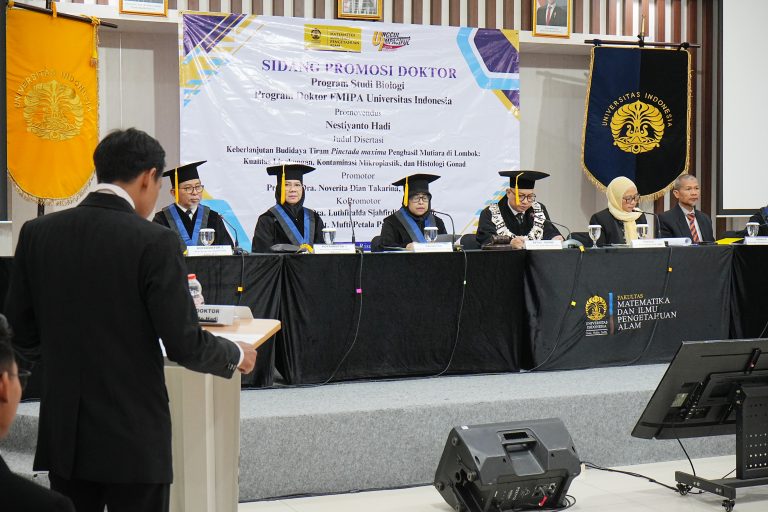
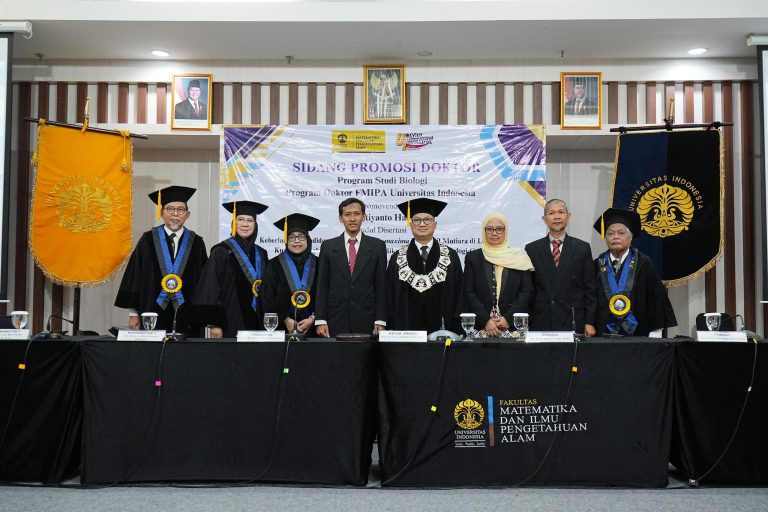
Nestiyanto defended his dissertation during the Doctoral Promotion of the Biology Study Program, FMIPA UI, held at the Pertamina Multidisciplinary Research Laboratory Building, FMIPA UI, Depok, on Thursday, July 9, 2026. He graduated with a GPA of 3.86 and earned the distinction of cum laude.
The research was motivated by the declining productivity of Pinctada maxima pearl oysters pearl oysters. pearl oyster farming on Lombok Island. This decline has been reflected in increasing larval mortality, slower oyster growth, and a reduced success rate of repeated grafting, the process used to cultivate pearls.
In a study conducted at pearl oyster farming sites in the waters of Sekotong, West Lombok Regency, between January and February 2025, Nestiyanto examined water environmental conditions, the presence of microplastics, and changes in oyster tissue following repeated grafting procedures.
The findings indicate that the waters of Sekotong remain suitable for pearl oyster farming. However, the study also identified several signs of environmental stress that warrant close attention.
Water temperatures were recorded at 32.8°C, exceeding the optimal range of 26–30°C for pearl oyster farming. In addition, salinity was measured at 28.1 parts per thousand (ppt), which is below the optimal range of 30–34 ppt required for healthy oyster growth.
These findings highlight the importance of positioning pearl oysters at water depths with more favorable environmental conditions. One of the study’s key recommendations is to adjust the buoyancy of the longline farming system to achieve an optimal cultivation depth that provides more suitable environmental conditions for oyster growth.
The study also found that microplastics are widely distributed throughout the farming waters and have accumulated in various oyster organs, including the gills, mantle, digestive tract, gonads, and muscle tissue.
The detected microplastics were predominantly granules, followed by films and fragments. The identified polymer types included polypropylene (PP), polyethylene terephthalate (PET), and polyamide (PA).
The highest concentrations of microplastics were found in the gills and mantle. These findings indicate that the microscopic plastic particles have entered the oysters’ biological system and may interfere with their metabolism as well as the formation of shells and pearls.
“This study shows that the sustainability of pearl farming is determined not only by cultivation techniques but also by environmental conditions and the biological health of oysters. Therefore, monitoring water quality, microplastic contamination, and oyster tissue conditions needs to be carried out in an integrated manner,” said Nestiyanto.
These findings are relevant to the national issue of marine plastic pollution. Plastic waste entering the ocean can threaten the sustainability of marine ecosystems, particularly as it breaks down into microplastics.
Therefore, this research provides an important contribution by demonstrating that microplastic pollution can have specific impacts on marine aquaculture commodities. The findings can serve as a foundation for strengthening environmental quality monitoring in aquaculture areas while supporting the development of more targeted pollution mitigation strategies.
In addition, the study showed that repeated grafting procedures can cause changes in the tissues responsible for forming the pearl sac. In oysters that had undergone repeated grafting, the researchers observed thickening of connective tissue, scar tissue formation, and chronic structural changes in the tissues.
Microplastics were also found to accumulate in the gonads, or reproductive organs, of oysters across all treatment groups. This condition is suspected to exacerbate tissue changes and reduce the efficiency of the pearl layer formation process.
Overall, this study demonstrates that changes in environmental quality, microplastic exposure, and alterations in oyster tissues are interconnected with the decline in pearl farming productivity.
Nestiyanto’s research integrated three approaches: ecology to assess environmental conditions, toxicology to examine the impacts of pollution exposure, and histology to observe changes in oyster tissues.
This approach is expected to provide a scientific foundation for more sustainable pearl farming management through habitat quality monitoring, microplastic pollution control, and assessment of oyster biological conditions prior to repeated grafting procedures.
Pearl farming is one of Indonesia’s economically valuable commodities. Lombok is recognized as one of the regions producing premium-quality marine pearls through the cultivation of Pinctada maxima pearl oysters.
Therefore, research on environmental and biological factors that influence oyster productivity is essential to maintaining the sustainability of Indonesia’s pearl industry. This study also highlights that addressing plastic pollution requires an integrated approach, ranging from waste management on land to monitoring its impacts on marine organisms and marine-based commodities.
In this research, Nestiyanto also developed the MABE PEARL (Monitoring and Assessment of Biotic and Ecosystem Parameters for Pearl Culture) application, which can assist farmers in assessing habitat suitability for pearl cultivation, identifying limiting environmental factors, and obtaining mitigation recommendations based on the measured parameters.
“These findings are expected to provide a foundation for farmers to determine habitat suitability, identify key limiting factors, and implement more appropriate mitigation strategies, allowing pearl farming productivity to be maintained sustainably,” said Nestiyanto.
The doctoral promotion was chaired by Prof. Dr. Tito Latif Indra, M.Si., Dean of FMIPA UI, who served as the chair of the examination committee. The research was supervised by Promotor Prof. Dr. Dra. Noverita Dian Takarina, M.Sc., with Co-Promotors Prof. Dr. Dra. Luthfiralda Sjahfirdi, M.Biomed., and Prof. Dr. rer. nat. Mufti Petala Patria, S.Si., M.Sc.